Products You May Like
Are your marketing efforts creating temporary spikes or sustainable growth? Why do so many businesses find themselves on a revenue-to-effort treadmill, constantly running just to stay in place?
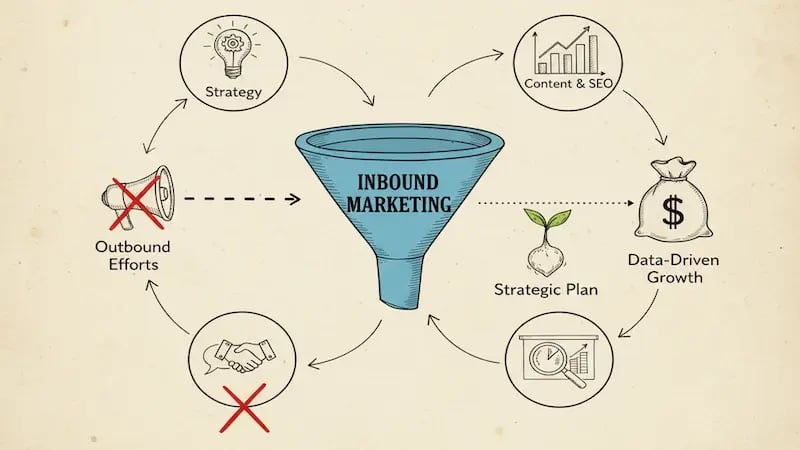 Many organizations confuse activity with strategy. Posting frequently, running short-term ad campaigns, and chasing fleeting trends are often mistaken for actual marketing progress. While these activities can generate traffic, they rarely form the basis of predictable, long-term expansion. Proper growth requires a system that runs efficiently and expands predictably: a scalable inbound marketing strategy.
Inbound marketing, at its core, is the philosophy of drawing high-quality customers in by creating valuable content and experiences, rather than interrupting them with aggressive sales tactics. But merely doing inbound isn’t enough. Scaling your marketing isn’t about increasing your budget linearly; it’s about building a robust, data-driven framework that delivers compounding returns.
Below, we’ll outline the foundational steps and core pillars required to build a truly scalable inbound strategy, transforming your marketing from a cost center into a reliable growth engine.
I. Foundation: Establishing the Scale Blueprint
If you were building a skyscraper, you wouldn’t start with the paint; you’d start with the blueprints and the foundation. The same principle applies to marketing. Scalable inbound marketing starts not with tactics, but with rigid planning and strategic definition.
Step 1: Document Your Strategy and Define Success
Do you have a documented plan that details your growth objectives, target audience, and content strategy? If the path isn’t written down and shared, how can you expect a diverse team to follow it consistently and effectively?
The data is clear: documentation drastically increases your odds of success.
According to research, 60% of content marketers who documented their strategy feltthat their organization was effective, versus only32%of those who verbalized it but did not documentit.
A documented strategy forces you to define measurable success. This means setting SMART goals—Specific, Measurable, Achievable, Relevant, and Time-bound. Connect these clear, quantifiable marketing objectives (e.g.,increasing organic traffic by 40% within 12 months) directly to high-level business outcomes (e.g.,generating$500k in pipeline value).
Furthermore, you must define scalable KPIs (Key Performance Indicators). Focus on metrics that signal long-term growth and efficiency, such as:
-
Organic Sessions
-
Content Topic Authority (how many keywords you rank for on the first page)
-
Lead-to-Customer Conversion Rate
-
Cost Per Acquisition (CPA) reduction
Vanity metrics, like likes or shares, are nice, but they don’t help you build a truly scalable system.
Step 2: Pinpoint the Awareness Stage Ideal Customer Profile (ICP)
To scale effectively, you must stop guessing who you’re talking to and, crucially, understand where they are in their buying journey.
Since this is an Awareness-stage strategy, we must focus on the broadest part of the funnel. Customers here are typically problem-aware, not solution-aware. They are searching for answers to their pain points, not necessarily for your specific product or service.
If you are trying to reach a business owner, their Awareness-stage pain points will sound like this:
-
“Why is my company’s revenue growth stalled despite increasing my ad spend?”
-
“How can I reduce my Cost Per Lead (CPL) without sacrificing quality?”
-
“What is a reasonable budget for marketing my SaaS product?”
Your scalable inbound marketing content must target these problem-aware terms. The primary keyword for this post—scalable inbound marketing—is an excellent Awareness-stage term because it asks a “how-to” question, indicating a search for foundational knowledge. A well-defined ICP ensures that every piece of content you create acts as a magnet for the right kind of business, not just any browser.
II. The Engine: Building Scalable Content and SEO
Once the blueprint is set, you need to build the engine that consistently attracts and converts your ICP. This is where strategic content and Search Engine Optimization (SEO) play a crucial role.
A. The Power of Attraction: Content as an Investment
Scaling requires content that works for you 24/7, year after year. Think of content marketing not as an expense that disappears, but as a long-term asset that appreciates over time, much like real estate. Every well-researched, optimized blog post becomes a new digital doorway to your business.
This long-term focus has significant cost benefits. Research consistently shows the economic advantage of inbound strategies:
Inbound leads cost approximately 39% less than leads generated through outbound methods like cold calling or paid advertising.
This cost efficiency is a core reason why inbound marketing is essential for a truly scalable model.
B. Creating High-Performance Awareness Content
Are your blog posts single points of light, or do they connect into a powerful, organized constellation? An accurate content scale comes from a structured system. We recommend the Pillar/Cluster content model.
-
Pillar Content: These are the long-form, definitive guides on broad, high-volume topics (e.g., The Ultimate Guide to Digital Marketing Strategy). They serve as the central hub of authority on a subject. A Pillar should thoroughly cover topics like “what defines a scalable inbound marketing approach?“
-
Cluster Content (The Awareness Focus): These are shorter, specific blog posts that address distinct questions or subtopics and link back to the Pillar. For the Awareness Stage, these posts should address the symptoms of a problem that the Pillar solves.
Examples of Awareness-Stage Cluster Content:
-
5 Signs Your Marketing Budget is Too High and How to Fix It
-
What is Customer Acquisition Cost (CAC) and Why It Matters for Growth
-
How to Set Marketing Goals That Drive Real Revenue
This structured approach not only improves organization but also signals to search engines that you are a comprehensive authority on a subject, thereby dramatically boosting your ranking potential. In fact,
Marketers who prioritize blogging are 13 times more likely to achieve a positive return on investment (ROI), proving that strategic content is the most powerful scaling lever you possess.
C. Scaling Through SEO and Distribution
How do you ensure your content reaches thousands without paying for every single click? Search Engine Optimization is the answer. For your content to power a scalable inbound marketing strategy, it must be discoverable.

SEO involves ensuring strong keyword integration (like organically using scalable inbound marketing throughout the piece), maintaining technical site health, and ensuring a positive user experience.
Scaling also demands efficiency. Content Repurposing is critical. One high-performing Pillar piece can be efficiently scaled into 10 smaller assets, maximizing the return on your initial content investment. Think: Blog Post > Infographic > Social Media Posts >Webinar Script.
Finally, leverage your owned media. Building and nurturing an email list, alongside consistent engagement on social channels, ensures you don’t solely rely on search engines. This diversified approach makes your entire strategy more resilient and, therefore, more scalable.
III. The Pillars of True Scale: Data, Automation, and Efficiency
If you want a strategy to handle growing traffic and leads without hiring a new employee every time you hit a milestone, you need the proper technological and analytical infrastructure. This is the heart of scalability.
A. Automation: The Force Multiplier
Scaling is simply impossible if your team is mired in repetitive manual tasks, such as moving spreadsheet data, sending repetitive emails, or performing basic lead qualification. Automation turns a one-to-one effort into a one-to-many system, fundamentally changing your capacity for growth.
Automation is not merely a convenience; it’s an investment with a powerful return.
According to industry analysis, marketing automation yields an average ROI of $5.44 for every $1 spent over the first three years.
Awareness Stage Automation Examples:
-
Automated Welcome Series: Instantly send a personalized email path after a user downloads an Awareness-stage lead magnet (e.g., an ebook on Marketing Strategy Fundamentals).
-
Dynamic Content: Automatically present tailored content or Calls to Action (CTAs) based on a user’s first blog visit.
-
Lead Scoring: Implement basic rules to automatically qualify leads based on their interactions (e.g., “read five blog posts and opened three emails”), ensuring sales only talk to interested prospects.
B. The Power of Data-Driven Decisions
If you cannot measure it, can you truly scale it? Scaling requires absolute precision. You must know what works, what doesn’t, and, most importantly, why.
Data is the key separator between average and high-growth companies.
Businesses utilizing data-driven strategies drive five to eight times as much ROI as businesses that don’t.
This precision is non-negotiable for a truly scalable inbound marketing model.
Key Analytical Actions for Scale:
-
Attribution Modeling: Identify exactly which Awareness content piece delivered the lead that ultimately became a customer. This enables you to reallocate resources to the most effective content.
-
Conversion Rate Optimization (CRO): Run small, continuous A/B tests on your Awareness-stage pages. Minor tweaks to the placement, color, or wording of CTAs on popular pages can deliver massive lead increases at scale without requiring increased traffic.
C. The Mentality of Scale: Continuous Optimization
A scalable inbound marketing strategy is never “finished.” It is a sophisticated machine that requires constant tuning, testing, and reinvestment. Scaling is not about setting it and forgetting it; it’s about committed, continuous optimization. By embracing a data-driven approach to testing headlines, optimizing content depth, and refining your automation pathways, you ensure that your engine remains efficient and grows in tandem with your business.
Beyond the Strategy
We have covered the three core components necessary to escape the marketing treadmill: the Foundation (Planning/Goals), the Engine (Content/SEO), and the Pillars (Data/Automation). Implementing this structured approach is what trulyunlocksscalableinbound marketing—turning unpredictable output into a predictable, compounding system.
Are you ready to move past ad-hoc, low-return tactics and invest in a system that generates compounding returns for years to come?
Building a truly scalable engine is a complex undertaking. It requires specialized expertise in SEO, automation architecture, content strategy, and advanced data analysis. If you recognize the necessity of this strategic shift but lack the internal resources or time to execute it with precision, seeking an expert partner is the most efficient path to scale.
This is where we step in. Aspiration Marketing specializes in crafting the precise, data-backed inbound foundations—from documented strategy to optimized automation—that transform stalled growth into sustainable, predictable scaling. Our focus is on building a high-performance framework that allows you tofocus entirely on your core business.
Discuss your current growth ceiling with a strategist and discover how our strategic approach can help you build your next engine for expansion.