Products You May Like
You know the scenario well. You have a lead. They seem perfect. They visit your website frequently. They download your latest whitepaper. They even click through on your nurturing emails. Your marketing automation software lights up with activity. You feel confident. You prepare for the conversion.
Then, silence.
 They vanish. They stop opening emails. They never book that demo. You are left wondering what went wrong. Did they find a competitor? Did they lose budget? Did they just lose interest?
This is the most frustrating part of the modern B2B sales cycle. It happens in the shadows. It happens outside of your view.
The truth is harsh but straightforward. Most of the decision-making process occurs without your involvement. In fact,
Between 70% and 90% of the buyer’s journey is complete before a prospect ever speaks witha sales representative.
Your buyers are researching, comparing, and deciding on their own terms. If you aren’t in the room when they choose, how can you influence the outcome?
To win in today’s market, you must move beyond listing features. You have to understand the psychology behind the click. You need tounderstandwhat deeply influences buyer decisions. It is a mix of logic, emotion, and risk management.
Let’s explore how you can meet these hidden needs with the right strategy.
The Psychology Behind the Decision
We like to think we are logical. In the business world, we pretend that every purchase is a cold calculation of ROI (Return on Investment). We look at spreadsheets. We compare feature lists. We act like robots.
But we are not robots. We are humans.
The reality of B2B buying is surprisingly emotional. While buyers use logic tojustifytheir decisions, they often rely on emotion tomakethe finaldecision.
Research supports this. According to the Harvard Business School,
Up to 95% of purchasing decisions are subconscious. They are driven by feelings, gut instincts, and social validation.
The Factor of Fear
What is the strongest emotion in B2B buying? It isn’t greed. It isn’t excitement.
It is fear.
In a high-stakes business environment, a bad purchase can damage a career. If a software implementation fails, the person who chose it takes the blame. They could lose political capital at work. They could even lose their job.
As a result, buyers are naturally risk-averse. They play it safe.
Data reveals a telling statistic:
Approximately80% of B2B buyersstate that avoiding a bad decision is more important to them than securing the absolute best deal.
This changes your goal. Your content cannot just say, “We are the best.” That is risky. “Best” implies change. “Best” implies unproven claims.
Instead, your content must say, “We are the safe, reliable choice.” You must prove that you are a partner who lowers their risk. You must make them feel safe.
The Three Pillars of Influence
Once you understand the fear factor, you can look at the external triggers. What are the specific inputs that a buyer looks for? When they are sitting in their office, trying to decide between you and a competitor, what tips the balance in your favor?
Three main pillars define what influences buyer decisions.
1. Social Proof and the “Trust Gap.”
Buyers have a trust issue. They do not trust your marketing department. They assume your website is biased. They think your sales team is just trying to hit a quota.
They do, however, trust strangers.
This is the “Trust Gap.” To bridge it, you need voices other than your own.
This means your “Consideration Stage” content must rely heavily on social proof. You cannot just claim you have excellent customer service. You need a verified review on G2 or Capterra that says it. You need detailed case studies that name real companies.
If you don’t have third-party validation, you are asking the buyer to take a leap of faith. Most of them won’t jump.
2. The Demand for Content Depth
Modern buyers are binge-consumers. They are hungry for data. They are building a case to present to their boss. To do that, they need ammunition.
They are not just reading one blog post. The average B2B buyer consumes 13 pieces of content during their purchasing journey before making a decision.
13 pieces.
Ask yourself: Do you have 13 pieces of high-value content for a single persona? Do you have comparison guides? Do you have technical spec sheets? Do you have implementation roadmaps?
If your content is shallow, the buyer hits a dead end. They will go to a competitor who provides the depth they need. You need a library that goes deep. You need to answer every specific, technical question they might have before they even ask it.
3. The Consensus Committee
You are rarely selling to one person. You are selling to a group.
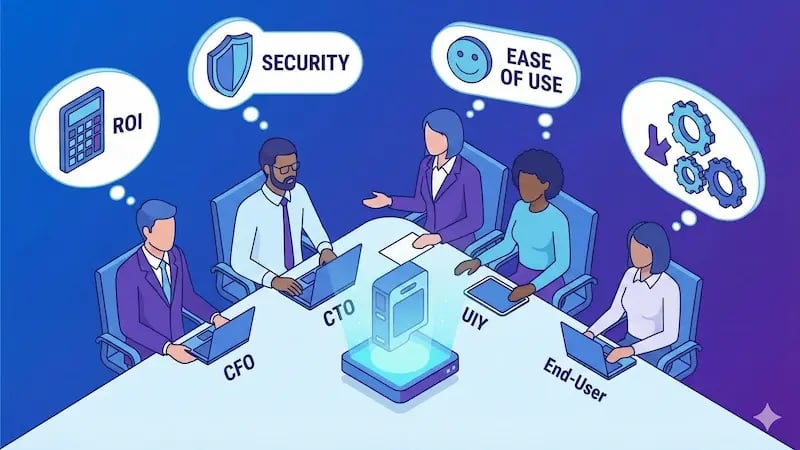
In complex B2B sales, the “buyer” is actually a committee.
Gartner reports that the average B2B buying group now includes 6 to 10 decision-makers.
Each of these people cares about something different.
-
The CFO is concerned with ROI and cost.
-
The CTO cares about security and integration.
-
The End-User cares about ease of use.
If your content only speaks to the End-User, the CFO will kill the deal. If you only speak to the CFO, the End-User will complain that the tool is too hard to use.
To influence the decision, you must multi-thread your content. You need specific assets for every person in that room.
Structuring Certainty: The BARB Framework
So, how do you write content that hits all these notes? How do you write a blog post that lowers risk, builds trust, and satisfies the committee?
You need a structure. An excellent method to use is the BARB Framework. This ensures your consideration-stage content is working hard for you.
B – Benefits (Not Features)
Stop listing features. Features are boring. Benefits are emotional.
Focus on the outcome. Focus on the relief the buyer will feel.
A – Alternatives
This is scary for many marketers, but it is necessary. You must talk about your competitors.
If you don’t mention them, do you think the buyer won’t find them? Of course they will. They are already Googling “Your Brand vs. Competitor X.”
If you write a comparison article, you control the narrative. You can be honest. You can say, “If you need X, Competitor A is great. But if you need Y, we are the better choice.“
This builds massive trust. It shows you aren’t hiding anything.
R – Risks
Address the elephant in the room. What are they afraid of?
According to recent data,86% of B2B purchases stall due to perceived risk. If you address that risk head-on in your content, you unstick the deal.
Write a section in your blog called “Common Implementation Challenges.” Tell them exactly how you solve them. It shows you have experience.
B – Best Practices
Finally, show them how to succeed. Don’t just sell the tool; sell the method. Share your expertise.
When you share best practices, you prove you are a thought leader. You confirm you are a partner who wants them to win, not just a vendor who wants their money.
Engineering the Decision: Data and Automation
You have the psychology. You have the content structure. Now, you need the technology.
Remember, the buyer is invisible for most of the journey. You cannot see them reading your comparison guide. You cannot see them forwarding your pricing page to their CFO.
Unless you have the right tools.
You need to “listen” digitally. This is where marketing automation (like HubSpot) becomes your best friend.
Behavioral Triggers
You can set up your system to watch for “high-intent” signals. These are digital body language cues that tell you a buyer is serious.
-
Low Intent: They read one blog post about general industry trends.
-
High Intent: They visit your pricing page, then your case study page, then your “book a demo” page, all in one hour.
You should not treat these two people the same.
When a lead shows high intent, you need a trigger to take action. Maybe it alerts a sales rep immediately. Perhaps it sends a specific email asking if they have technical questions.
The Power of Personalization
Generic email blasts kill deals in the decision stage. If a buyer is trying to decide between you and a competitor, a generic newsletter about “Company News” is unlikely to be beneficial to them.
They need context.
-
If they looked at “Enterprise Pricing,” send them an Enterprise Case Study.
-
If they looked at “Security Features,” send them your security whitepaper.
This is nurturing. And it works.
Companies that excel at lead nurturing generate 50% more sales-ready leads at a 33% lower cost.
Furthermore,
Personalized nurturing generates 20% more sales opportunities compared to non-personalized approaches.
The Hand-off
This is the final mile. You have nurtured the lead. You have provided content that lowers risk. They are ready.
Now, you must hand them to sales.
But don’t just give the sales rep a name and phone number. Please give them the data. “This is Sarah. She read our pricing guide, our security doc, and the comparison against Competitor X.”
Now, your sales rep isn’t making a cold call. They are having a warm consultation. They know precisely what influences buyer decisions for this specific buyer.
Ready to Navigate the Journey?
The days of the “hard sell” are over. You cannot force a buyer to choose you. You can only guide them.
The modern buyer is smart. They are skeptical. They are surrounded by risks and committees.
To win their business, you must respect their journey. You must understand the psychology of fear and safety. You must provide deep, honest content that answers their questions before they ask them. And you must use data to deliver that content at the exact right moment.
It is not about being the loudest voice in the room. It is about being the most helpful.
When you provide clarity in a confusing market, you don’t just get a sale; you also gain a loyal customer. You get a loyal customer.
Building a strategy that addresses these hidden factors is not easy. It requires a blend of psychological insight, content creation, and technical automation.
If you are looking to build a system that turns consideration into conversion, Aspiration Marketing is here to help. We specialize in Inbound Marketing and HubSpot implementation to align your teams and clarify your message. We help you create the kind of journeys that buyers appreciate—and the kind that drive real revenue.
Contact us today to audit your current Buyer’s Journey.