Products You May Like
Have you ever felt like your marketing and sales teams are speaking two different languages? It is a common frustration. You see your marketing team hitting their lead goals month after month, yet the sales floor remains quiet. Or perhaps your sales team is closing deals, but your customer successteamis struggling with a wave of unhappy new clients who feel they were promised something entirely different.
 When growth stalls, the first instinct is often to hire more people or buy a new piece of software. However, more “stuff” rarely fixes a fundamental disconnect. If your revenue engine is clunky, adding more fuel just makes the smoke thicker. This is where the concept of RevOps 101 comes into play. It is not just a new corporate buzzword or a fancy name for administrative tasks. Instead, it is a strategic shift in how a business operates.
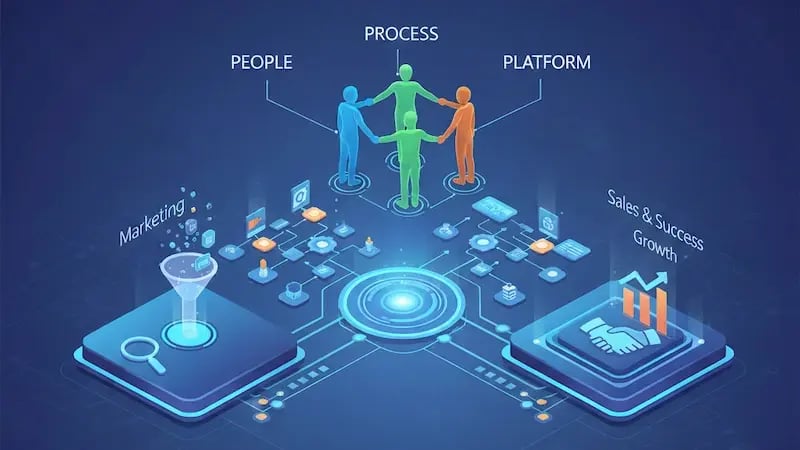
The core of this shift is the revenue operations framework. This framework moves away from the idea that marketing, sales, and service are separate silos. Instead, it views them as a single, continuous engine. By aligning your people, your processes, and your platforms, you can stop the “blame game” and start focusing on predictable, sustainable growth.
Why the Traditional “Funnel” is Failing
For decades, we have been taught to think about business as a linear funnel. You pour leads in at the top, marketing “nurtures” them, and they get tossed over to sales; eventually, a customer emerges atthe bottom. But have you noticed how often those leads “fall over the wall” and disappear?
This linear model creates a hand-off culture. When teamsfocus solely on their specific sliceof the funnel, they lose sight of the human being on the other end. Marketing celebrates reaching a “lead count” even if those leads never convert into sales. Sales gets frustrated with lead quality. Customer success inherits a relationship built on mismatched expectations.
The reality of modern business is that the buyer’s journey is not a straight line. It is a lifecycle. Customers move back and forth between stages. Theyconduct their own research, jump into trials, andexpect every person they talk to at your company to know exactly who they are and what they need.
Research shows that this lack of alignment is expensive. In fact, companies with poorly aligned teams can waste a significant portion of their potential earnings.
According to datafrom IDC, organizations lose an average of 10% or more of their annual revenue due to friction and misalignment between departments.
RevOps is the tool used to bridge that gap.
What is RevOps, Really? (Beyond the Admin Work)
Many people hear “Operations” and think of spreadsheets, CRM data entry, or fixing broken links in an email. While those tasks are part of the daily work, RevOps is much bigger than that. It is the orchestration of your entire Go-to-Market (GTM) strategy.
Think of your company like an orchestra. Your marketing team is the woodwinds, sales is the brass, and customer success is the strings. Without a conductor, you just have a lot of noise. RevOps is the conductor. It ensures everyone is playing from the same sheet music, at the same tempo, toward the same goal: revenue.
A proper revenue operations framework is built on three essential pillars:
-
People: The teams responsible for generating and keeping revenue.
-
Process: The workflows and rules that guide those teams.
-
Platform: The technology stack that enables the work.
When these three pillars are in sync, the results are measurable.
Organizations that adopt a centralized RevOps model often see a 15% to 20% increase in internal efficiency.
This happens because the “busy work” is automated, and the “guesswork” is replaced by data.
Pillar 1: People (Cultural Alignment over Org Charts)
The most essential part of RevOps 101 is not the software—it is the people. You can have the best CRM in the world, but if your Sales Manager and Marketing Director are not on the same page, your growth will stay flat.
Alignment starts with a shared language. Ask yourself: Does “MQL” mean the same thing to your marketing team as it does to your sales team? In many companies, marketing views a whitepaper download as a lead, while sales considers a lead to be someone ready to see a demo. This disconnect creates immediate friction.
RevOps encourages a shift in accountability. Instead of marketing being measured solely on volume and sales being measured solely on closed deals, both teams start looking at shared KPIs like:
-
Customer Acquisition Cost (CAC): How much does it cost us to get a new customer across all departments?
-
Pipeline Velocity: How fast are prospects moving through the entire lifecycle?
-
Lifetime Value (LTV): Are weattracting therightcustomerswho will remainwith us long-term?
When people share the same goals, the “hero culture” begins to fadeaway. It is no longer about one “rockstar” salesperson saving the quarter. It is about a consistent team effort that drives results.
According to Forrester, highly aligned companies grow 19% faster and are 15% more profitable.
Pillar 2: Process (The Architecture of Revenue)
Once your people are aligned, you need a map. This is where process comes in. Without a documented process, your teams are just winging it. This leads to inconsistent customer experiences and, more importantly,revenue leakage.
Revenue leakageoccurswhen a prospect shows interest but never receives a follow-up, or when a current customer has a problem that goes unaddressed because it falls under“nobody’s job.” RevOps maps out the entire customer journey from the first touchpoint to the final renewal.

A major part of this process is maintaining your “Single Source of Truth.” If your marketing team uses one database and your sales teamuses another, your data will inevitably become “dirty.” We often talk about the high cost of dirty data. When your leads are “rotting on the vine,” it is usually because the process for managing them is broken and your CRM data hygiene is lacking.
How bad is the data problem?
Forrester notes that nearly 25% of the average B2B marketing database is inaccurate.
This means your sales team is wasting a quarter of their time chasing ghost leads or calling disconnected numbers. Arobustrevenue operations framework streamlines this process by automating data entry andestablishing clear guidelines for capturing information.
Pillar 3: Platform (Tools as Enablers, Not Solutions)
We have all been there: you buy a new software tool because it promises to “solve your problems,” but six months later, no one uses it, and your problems are still there. This is known as TechDebt.
In a RevOps model, the platform (the tech stack) is meant to support the people and the process, not replace them. Instead of a “Franken-stack” of twenty different tools that do not talk to each other, RevOps focuses on integration.
Your CRM should be the heartbeatof the company. Every interaction—an email opened, a meeting booked, a support ticket filed—should be visible to everyone. This transparency allows your teams to provide a better experience. Imagine a salesperson calling a prospect and already knowing which blog posts they read this morning. That is the power of a unified platform.
Professional teams, such as those at HubSpot or our own Onboarding and Training consultants, emphasizethat platform success stems from proper onboarding and implementation. You cannot just “turn on” a tool like HubSpot and expect it to work. It must be built around your specific business rules. When the platform aligns with your process, your team can spend less time fighting with software and more time interacting with customers.
The Business Case: Why Transition to RevOps Now?
If you are in the awareness stage of your growth journey, you might be wondering if RevOps is worth the effort. Is it really necessary for a mid-market company?
The answer lies in predictability. Without RevOps, growth feels like a roller coaster. You have great months and terrible months, and you’re not quitesure why either happens. With RevOps, you gain visibility into your revenue engine.You can see exactly where prospects are getting stuck and what actions move them forward.
Furthermore, the competitive landscape has undergone significant changes. Buyers have more power than ever. They expect a seamless, personalized experience. If your internal teams are siloed, your customer will feel that friction. They will receive repetitive emails, have to repeat their story to three different people, and eventually go to a competitor who makes things easier.
Investing in RevOps is an investment in your company’s future value.
According to Boston Consulting Group, companies that successfully align their revenue functions can see a 10% to 20% increase in sales productivity.
That is a massive gain without hiring a single new rep.
Preparing Your Engine for Scale
The journey toward RevOps is not an overnight transformation. It is a process of identifying the cracks in your foundation and filling them one by one. It starts by asking the hard questions:
-
Do our departments have conflicting goals?
-
Do we have a documented process for how a lead becomes a customer?
-
Is our data clean enough to actually make decisions?
If the answer to any of those is “no,” you are likely leaving money on the table. You are working harder than necessary, and your team is likely more stressed than they should be.
At Aspiration Marketing, we specialize in helping companies move from siloed chaos to a streamlined growth engine. We understand that RevOps is about more than just setting up a CRM; it is about creating a culture of alignment. Whether you are dealing with the high cost of dirty data or you need a complete revenue operations framework to scale your business, we are here to help you bridge the gap.
Your growth does not have to be a mystery. By focusing on RevOps 101—aligning your people, processes, and platforms—you can transformyour business into a predictable, revenue-generating machine.
Reach out if you’d like us to help your organization conduct a quick audit of your current lead-to-revenue process to see where your most significant gaps might be.