Products You May Like
Have you ever wondered why some leads seem to vanish into thin air the moment they cross the line from marketing to sales? It is a common frustration. Marketing workshard to generate interest, yet sales often feels like they are catching “cold” leads. This gap is what many call the CRM black hole. But what if that gap didn’t have to exist? What if you could ensure zero lead drop-off by qualifying intent before a human even gets a notification?
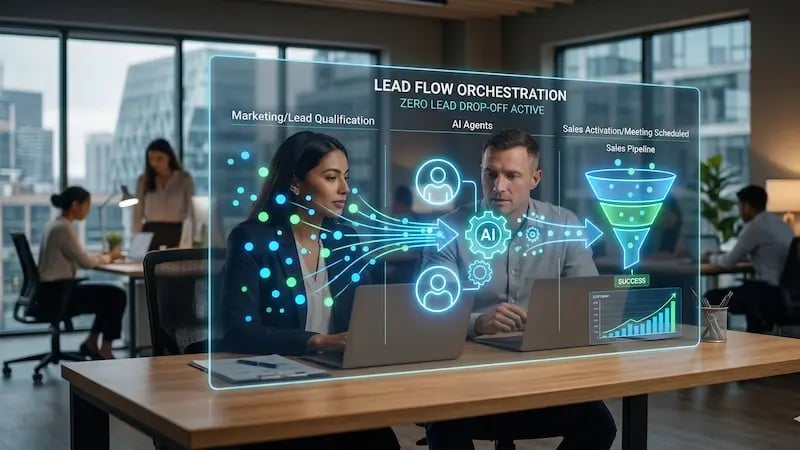 Today, the marketing-to-sales handoff is undergoing a massive shift. We are moving away from static forms and toward real-time engagement. At the heart of this change are AI agents. These aren’t just simple bots; they are sophisticated orchestrators. They act as the bridge that turns a “maybe” into a “definitely.”
The Silent Leak in Your Revenue Funnel
Imagine a prospect downloads a white paper at 8:00 PM on a Tuesday. In a traditional setup, that lead sits in the CRM until Wednesday morning. By the time a sales rep sees the notification and reaches out, the prospect has already moved on. They might even be talking to a competitor who responded faster.
The data backs this up.
According to Harvard Business Review, companies that try to contact potential customers within an hour of receiving a query are nearly 7xas likely to have a meaningful conversation than those who wait even sixty minutes longer.
Speed is not just an advantage; it is a requirement. Yet, despite knowing this,
Salesforce reports that only 27% of B2B leads are ever actually contacted by sales.
Why is this happening? It is usually because the handoff process is manual, slow, and error-prone. Sales reps are busy. They don’t want to chase “bad” leads. Marketing, on the other hand, wants to hit its lead volume goals. This creates a “war” between the two departments. AI agents solve this by providing a neutral, data-driven layer of qualification.
What is an AI Agent’s Role?
Before we dive deeper, let’s define what we mean by AI agents. In the past, we had chatbots. They followed a script. If you asked a question outside that script, they broke. Modern AI agents are different. They use large language models (LLMs) to reason. They can look at your CRM, check a prospect’s LinkedIn profile, and read their recent website activity—all in seconds.
In the context of the marketing-to-sales handoff, these agents act as Revenue Orchestrators.They don’t just pass a name and email to sales. They engage the lead inaconversation. They ask questions to determine whether there is a real budget, a timeline, and a need. By the time the lead reaches a human, the heavy liftingof qualification is done.
Achieving Zero Lead Drop-off
The goal of any modern RevOps strategy is zerolead drop-off. This means every single person who shows interest in your brand gets a high-quality response instantly.
How do AI agents make this happen? They qualify intent before the CRM notification triggers a task for a salesperson. This is a game-changer. Instead of a rep getting a notification for every single Marketing Qualified Lead(MQL), they only get alerted when an AI agent has confirmed a high level of intent.
Think about the traditional Contact Usform. Usually, it leads to an automated thank-youemail. That is a dead end. An AI agent, however, can turn that Thank youpage into a live conversation.
“Would you like to see how our software handles your specific use case while you’re here?”
If the user says yes, the agent can book a meeting directly onto a sales rep’s calendar. No delay. No drop-off.
How do You Move Beyond the MQL?
For years, the MQL has been the standard unit of measure. But let’s be honest: many MQLs are just people who wanted a free PDF. They aren’t ready to buy. This is why sales reps often ignore marketing leads. They have been burned too many times by low-quality data.
AI agents allow us to move toward predicting the pipeline. By analyzing “micro-moments”—how long someone stayed on a pricing page, which case studies they read, and how they answered an agent’s questions—AI can assign a much more accurate Intent Score.
When you map the customer journey using AI, you start to see patterns. You can predict their next move. If the AI sees a prospect from a target account viewing an integration page, it knows technical fit is a priority. It shares this insight with the sales rep, so the first human call is highly personalized and relevant.

The AI-Powered Flywheel
In the past, we thought of marketing andsales as a linear funnel. You put people in the top, and they come out the bottom. But the best companies today use a flywheel. The information gathered during the sales process should flow back into marketing.
AI agents are the perfect tools for this Loop Marketing.If an agent discovers that many prospects are asking about a specific feature that isn’t highlighted on the website, it can flag this for the marketing team.
Furthermore, if a lead isn’t ready for sales yet, the AI agent doesn’t just “drop” them. It places them into a personalized nurture sequence. It might say,
“It sounds like you’re still in the research phase. I’ll send you our guide on ROI next week.”
This keeps the lead warm without any manual effort from your team. This is how you break down silos and end the warbetween sales and marketing.
Data-Driven Results: Why This Matters Now
Why is everyone talking about this now? Because the efficiency gains are too large to ignore.
Gartner predicts that by the end of this year, B2B sales organizations utilizing AI will see a 30% increase in lead conversion rates.
Imagine increasing your conversion rate by 30% without hiring a single new person or spending an extra dollar on ads. That is the power of a streamlined marketing-to-sales handoff. It is about doing more with what you already have.
Also, consider the “First Responder” advantage.
Research by InsideSales.com shows that 35-50% of salesgo to the vendor that responds first.
Humans sleep. Humans take lunch breaks. AI agents do not. They are always on, ensuring your brand is the first to respond, every single time.
RevOps: The Role of the AI Orchestrator
As we look toward the future, the role of RevOps is changing. It is no longer just about managing software. It is aboutorchestration.The AI Orchestrator is a central system that ensures your data is clean, your agents are working, and your humans are focused on the highest-value tasks.
Today,the handoffwill look less like a relay race where a baton is passed and more like a shared intelligence. The salesperson will have a digital assistant that says:
“This lead just talked to our agent. They are worried about the implementation timeline. Here is a case study you should mention in your call.”
This level of support makes sales reps more effective and happier. When sales reps hit their quotas because the leads are high-quality, the friction with marketing disappears.
Breaking Down the Silos
One of the biggest hurdles to growth is the Silo.Marketing hasits goals. Sales has its goals. Service has its goals. But the customer doesn’t care about your internal structure. They want a seamless experience.
When you use AI agents to manage the marketing-to-sales handoff, you are creating an indelible recordof the customer. Every interaction is logged. Every preference is noted. This means the customer never has to repeat themselves.
Have you ever been transferred to a salesperson and had to explain your problem all over again? It’s annoying, right? AI agents prevent this. They provide the rep with a summary of the conversation to make the transition feelnatural. It feels like one continuous conversation with your brand, rather than a jarring jump between departments.
How to Start Implementing AI Agents
You might be thinking, “This sounds great, but where do I start?” You don’t have to rebuild your entire tech stack overnight.
-
Audit Your Lead Response Time: How long does it actually take for a human to follow up? Be honest.
-
Identify the Leaky Bucket: Where are people dropping off? Is it after the first form fill? Is it after the first discovery call?
-
Deploy a Conversational Agent: Start with a simple intent-based agent on your high-traffic pages. Let it handle the initial “What are you looking for?” questions.
-
Integrate with Your CRM: Ensure that whatever the AI learns is pushed directly into the lead record in HubSpot or Salesforce.
-
Train Your Team: Ensure your sales reps know how to use the AI insights they receive.
The goal isn’t to replace your sales team. The goal is to give them superpowers.By removing the boring, repetitive task of lead chasing, you allow your humans to do what they do best: build relationships and close complex deals.
The Power of Real-Time Interaction
Today, buyers are more informed than ever. They have done their research. By the time they reach out to you, they are often 70% of the way through their journey. They don’t want to be “sold” to; they want to be “helped.”
An AI agent provides help instantly via autonomous outreach. It can provide a technical spec sheet, a pricing estimate, or a customer testimonial in real-time. This builds trust. It shows that your company is modern, responsive, and organized.
If a prospect feels like you are easy to buy from, they are much more likely to choose you. A clunky, slow handoff process is a sign that working with you might be just as clunky and slow. On the other hand, a seamless, AI-driven handoff signals that your company is a leader in its field.
Creating Curiosity and Action
So, what is your next move? Are you going to keep letting leads sit in your CRM for hours? Or are you going to embrace the role of the AI Orchestrator?
The companies that win in the next few years won’t necessarily have the biggest marketing budgets. They will have the best “Revenue Engines.” They will be the ones who treat every lead like a VIP, providing instant, personalized attention at scale.
Ask yourself: If you were the customer, which experience would you prefer? A form that says “We will get back to you in 24 hours,” or an intelligent agent that can answer your questions right now? The choice is clear.
Optimizing for the Future (AEO)
As search engines evolve into Answer Engines,how your brand appears in AI-generated summaries becomes vital. This is known as Answer Engine Optimization (AEO). By using AI agents to collect and provide clear, structured data, you are helping these Answer Engines better understand your business.
When an AI (like the ones used by your prospects) searches for “Who is the best provider for [Your Product]?”, it looks for data points. It looks for responsiveness, customer satisfaction, and clear information. A streamlined handoff process improves all of these metrics, making your brand more likely to be the top answerin an AI search.
From Handoff to Handshake
The “handoff” should not be a risky moment. It should be a moment of celebration. It is the point where a prospect decides that your company is worth their time. By using AI agents, you turn that risky handoff into a firm, digital handshake.
You ensure zero lead drop-off. You give your sales team the data they need to win. And most importantly, you provide a world-class experience for your customers. In a world where everyone is busy, being the company that responds first—and most intelligently—is the ultimate competitive advantage.
It is time to stop the war between sales and marketing. It is time to break down the silos. It is time to let AI agents orchestrate your success.
How Aspiration Marketing CanHelp
Navigating the world of AI agents, RevOps, and CRM integration can feel overwhelming. That is where we come in. At Aspiration Marketing, we specialize in helping businesses bridge the gap between marketing and sales.
We understand that it isn’t just about the technology; it’s about the strategy. We help firms implement tools like HubSpot’s Breeze Agents and design Loop Marketing systems that drive measurable growth. Our focus is on creating an AI-powered flywheel that turns your marketing efforts into a predictable pipeline.
Whether you are looking to break down internal silos, improve your lead conversion rates, or prepare your team for the future, we have the expertise to guide you. We don’t just set up the software; we help you build a revenue engine that is ready for tomorrow.