Products You May Like
You’ve spent weeks planning a high-stakes webinar. You’ve coordinated guest speakers, refined your slide deck, and polished your delivery. The live event is a success, the recording is saved, and you hit “upload” to your resource library. But then, the silence sets in. After the initial social media push, that valuable video often sits in a digital vault, its insights locked away from search engines and, more importantly, from Answer Engines that could recommend your brand to thousands of users who may prefer reading towatching.
 Does this cycle sound familiar? In the current digital landscape, video is the most engaging medium we have, but it remains stuck in a black box when it comes totraditional search and AI discovery. While AI models are improving at indexing video, they still primarily rely on well-structured written text to generate answers for users.
The Digital Coffin
Truthfully, a video without a blog cluster isn’t content; it’s a digital coffin. Marketers need to stop burying their best insights in a format that search and answer enginescan’t digest.
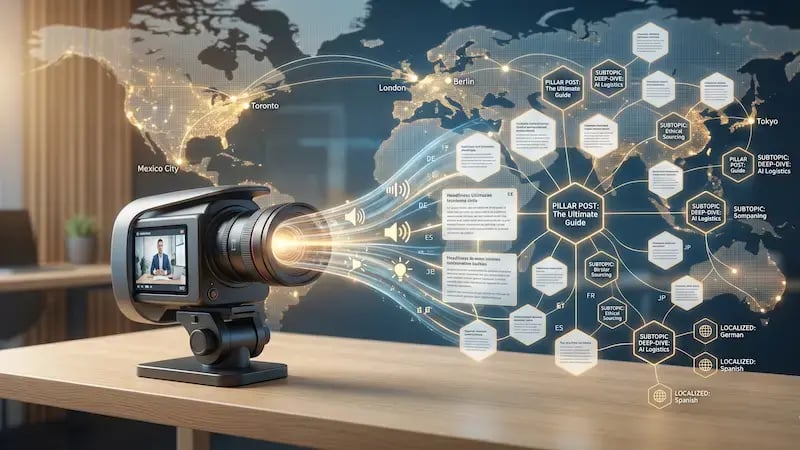
If you use your video only once, you are leaving an immense amount of content equityon the table. The shift we are seeing today isn’t just about making a video; it’s about using that video as the engine foraglobalblog cluster. By repurposing video content into an interconnected ecosystem of articles, you can turn one hour of footage into 20 or more multilingual blog posts optimized for both humans and AI agents.
Why does this matter? Because,
Websites with video contentare 53xmore likely to rank on the first page of Google results.
However,
With video accounting for 82% of all internet traffic, simply having the video isn’t enough to stand out.
You need a text-based strategy that makes your insights discoverable, readable, and—most importantly—indexable for Answer Engine Optimization (AEO).
Why “Global Blog Clusters” are the Key to AEO
To understand why this strategy works, we first have to look at how search has evolved into discovery. We have moved past the era of keyword stuffing. Today, search engines and AI models use semantic search to understand the relationship between topics. This is where Topic Clusterscomein.
A topic cluster consists of a Pillar Page—a comprehensive guide on a core topic—and multiple Subtopic Blogsthat link back to it. For AEO, this structure is gold. AI models don’t just look for a keyword; they look for authority and context. When you have a cluster of 20 blogs all derived from a single expert video, you provide a knowledge graphthat AI agents can easily parse to provide a direct answer to a user’s query.
When we talk about repurposing video, we are taking this a step further by adding a global layer. Why limit your expertise to one language?
Data shows that 72% of consumers spend most of their time on websites in their own native language.
If your video is only in English, you are effectively ignoring nearly three-quarters of the global market.
By creating a global blog cluster, you aren’t just translating; you are localizing for AI. You are taking the core truthof your video and adapting it so that an AI providing an answer in German or Spanish sees your brand as the primary, local authority.
The 1-to-20 Strategy: Anatomy of a Webinar Transformation
How do you actually turn one webinar into 20 blogs? It sounds like a lot of work, but applying AI to content marketing streamlines the process. Let’s break down the anatomy of this transformation.
Imagine a 60-minute technical webinar about “The Future of Sustainable Supply Chains.” Instead of just posting the transcript, you can architect a cluster that feeds both searchers and Answer Engines:
-
The Pillar Post (1 Blog): This is your “Ultimate Guide.” It covers every major point mentioned in the video. It is long, authoritative, and serves as the hub.
-
The Deep-Dive Subtopics (4 Blogs): You identify four key segments within the video. Perhaps one segment focuses on “AI in Logistics,” another on “Ethical Sourcing,” a third on “Last-Mile Delivery,” and a fourth on “Regulatory Compliance.” Each becomes its own detailed blog post.
-
The Multilingual Expansion (15 Blogs): You take those five English posts (1 Pillar + 4 Subtopics) and use AI Content Agents to recreate them in four other key languages.
Suddenly, your one-hour investment has yielded 20 distinct entry points for your brand. This is the power of repurposing video through a strategic lens.
But a common concern arises: won’t the content feel thin or repetitive? Not if you use your video as the exclusive source of truth. The AI isn’t “guessing” what to write; it is extracting the unique insights, data points, and quotes provided by your subject matter experts during the recording. This ensures that the 20 blogs are high-quality and carry the information that Google and AI models now require for high rankings.
Overcoming the “Generic AI” Hurdle with Semantic Triples
One of the biggest risks in modern content creation is the “generic” feel of AI-generated text. If your blog sounds like every other AI-written piece on the internet, it won’t be picked up by Answer Engines. AI agents prefer sources that show clear, structured logic.
To solve this, expert content creators are moving away from simple prompting and toward Content Agents. These are specialized tools designed to handle complex tasks like technical documentation and brand-aligned blogging.
A key concept here for AEO is the Semantic Triple. In the world of LLMs, a triple consists of a Subject, Predicate, and Object.
For example:
“The Software (Subject) automates (Predicate) the workflow (Object).”
By teaching AI to focus on these triples based on your video transcript, you ensure the technical accuracy of your content remains intact across all languages.
When you use specialized agents—like the Breeze Content Agent—you go far beyond a generic first draft. You’re able to maintain a specific “expert voice” that reflects the actual humans in your video. This is crucial for building the E-E-A-T (Experience, Expertise, Authoritativeness, Trustworthiness) that both Google and Answer Engines use to vet their sources.

The ROI of Repurposing: Scaling Without Breaking the Budget
Let’s talk about the bottom line. Content creation is expensive. Hiring a team of writers to produce 20 high-quality, researched blogs from scratch could take months and cost tens of thousands of dollars.
Repurposing is the ultimate “force multiplier.” You have already paid for the expertise when you produced the video. Now, you are simply changing the format of that expertise to reach more people and more AI agents.
Statistics show that organizations can reduce their content and translation costs by 25% to 31% simply by adopting structured content reuse strategies.
Instead of starting at zero for every new blog post, you are starting at 70% because the core ideas already exist in your video.
Think of it this way: if you produce one webinar per month and turn it into 20 blogs, by the end of the year, you have 240 high-performing, multilingual assets. That is a massive digital footprint built from just 12 hours of original video recording.
Best Practices for an AEO-Ready Video-to-Blog Workflow
To make this strategy work, you need a repeatable process. You can’t just throw a transcript at a chatbot and hope for the best. Here is how to do it right:
-
Start with Quality Transcription: Use high-fidelity AI transcription tools to ensure the source material is clean. If the AI mishears a technical term in the video, that error will cascade through all 20 blogs.
-
Identify the “Answer” for Each Subtopic: AEO is all about answering questions. For each blog in your cluster, identify a specific question it answers (e.g., “How does AI improve last-mile delivery?”). Place the answer clearly and early in the post.
-
Optimize for Answer Engines (AEO): Use clear headings, bullet points, and direct, concise sentences. AI-driven search engines (like Perplexity or Google’s SGE) love content that is easy to parse and scrapefor a featured response.
-
Keep a Human in the Loop: While AI does the heavy lifting, 86% of marketers still manually edit AI content to ensure the “expert voice” is perfect. A human should always give the final stamp of approval to ensure the tone is just right.
-
Strategic Internal Linking: Ensure every subtopic blog links back to your pillar page and vice versa. This creates a “web” of authority that tells both humans and AI bots exactly how your content is organized.
Future-Proofing: Thriving in the Age of Answer Engines
We are firmly in an era where users aren’t just looking for a list of links; they are looking for a direct answer to a complex question. If your brand doesn’t show up in that “AI snapshot” at the top of the screen, you are losing visibility.
If you have a global blog cluster, you are providing the contextualdepth that these engines need. When someone asks an AI, “What are the latest trends in sustainable logistics?” the AI searches for sources that cover the topic from multiple angles. A single video might be hard for the AI to readquickly, but a cluster of five detailed blogs in that user’s native language is a goldmine of information for the AI to cite.
By repurposing video, you are essentially feedingthe search engines of the future exactly what they want: factual, structured, and authoritative data that answers specific user intents.
Bridging the Gap to a Global Audience
The beauty of this approach is that it is both direct and approachable. You aren’t just creating content for the sake of “more content.” You are creating a better experience for your users and a more efficient path for AI to find you.
Imagine a potential customer in Tokyo who is looking for exactly the solution you discussed in your webinar. Because you repurposed that video into a Japanese blog post, they found your brand through an AI-generated answer on their mobile device. They didn’t have to struggle through a 60-minute English video; they got the answers they needed in their own language, in a format they could skim in five minutes.
That is how you build a global brand. It’s about being helpful, being present, and being accessible to both humans and the technology they use to find information.
Transforming Your Content Architecture
Moving froma content creatormindsettoa content architectmindset is the key to scaling today. Instead of wondering what to write about next week, look at the webinars, interviews, and presentations you already have.
You are sitting on a mountain of untapped value. Every video you’ve made is a seed that could grow into a forest of global blog posts. The technology to do this at scale—without sacrificing quality—is already here.
At Aspiration Marketing, we specialize in helping businesses bridge the gap between high-level video production and high-performing global SEO and AEO. We understand that your expertise is your most valuable asset, and we use advanced tools like the HubSpot Content Agent to ensure that expertise is shared with the world.
Whether it is turning a single technical session into a multilingual documentation hub or building a year’s worth of social content from one keynote speech, we help you stop the “one and done” video trap. The future of content isn’t just about being seen; it’s about being the answer—no matter what language your audience speaks.
Are you ready to turn your video library into a global authority engine? It starts with a single video, a smart strategy, and the right AI partners to help you scale.