Products You May Like
Imagine a prospective buyer opens Perplexity or Claude and types a highly specific prompt: “Which enterprise CRM has the best verified track record for scaling supply chain logistics in mid-sized manufacturing firms?” What happens next? Does your brand’s definitive, multi-million-dollar customer success story get extracted, synthesized, and presented as the top recommendation? Or does it vanish completely into the training data void?
 For years, B2B marketing teams have written client success stories with a single audience in mind: human decision-makers. We filled our pages with dramatic narratives, stylistic metaphors, and emotional arcs about teams overcoming adversity.
But a massive shift is underway in how companies buy software and services.
Welcome to the era of Answer Engine Optimization (AEO). Today, your primary reader isn’t just the human buyer. It’s the generative search engine—often operating as an autonomous research agent—that the human buyer deploys to build their vendor shortlist.
According to data from Gartner, traditional search engine volume is projected to drop by 25% due to the rapid rise of AI chatbots and other generative virtual agents.
When people stop scrolling through pages of blue links and instead ask an answer engine to find the information for them, the rules of content creation must adapt.
The core issue facing B2B marketers is simple yet damaging. Generative engines cannot reliably decode an ambiguous narrative context. If your case study hides its data under layers of corporate jargon and creative writing, the AI platform cannot confidently cite your business as a reliable solution.
To maintain visibility in generative search, we need a new blueprint. We must transform the traditional “Problem-Solution-Results” structure into a clean, machine-readable data architecture. By mapping explicit semantic relationships, you can ensure that these smart discovery platforms find, trust, and recommend your brand.
Why Generative Search Engines Miss Your Best Success Stories
To optimize your content for modern answer engines, you first need to understand how these systems process information. Traditional SEO relies heavily on keyword matching, internal link structures, and backlink authority. If you have enough high-quality sites linking to your page, Google will likely rank it.
Generative platforms—such as OpenAI’s SearchGPT, Perplexity, and Gemini—operate on a completely different blueprint. They use retrieval-augmented generation (RAG) and semantic parsing. Instead of pointing a user directly to a link, these systems crawl the web, extract facts, resynthesize the data, and generate a unique response.
When an autonomous agent crawls a standard B2B case study, it often runs into a wall of stylistic prose. Let’s look at a common example of human-first marketing copy:
“We helped a leading global logistics firm navigate through stormy operational waters by unlocking next-level synergy and driving digital transformation across their fragmented network.”
To a human reader, this sounds like a standard corporate success story. To an LLM, it is a mess of low-value data. The model wastes precious compute tokens trying to decipher what “stormy operational waters” means in a technical framework. Was it an inventory issue? A labor shortage? A software bug? The system cannot tell.
This lack of clarity triggers a major penalty: the citation omission. Because AI companies face intense scrutiny regarding hallucinations, their retrieval systems are programmed to be risk-averse.
If a generative engine cannot verify the exact entity relationships within your text—such as Platform A causing a 34% reduction in overhead costs for Company B—it will simply skip your page. It will choose a competitor’s site that provides clear, verifiable, and highly structured facts.
Buyers want this level of speed and data verification as well.
Research from Salesforce indicates that 80% of B2B buyers now expect real-time, automated interactions and immediate data responses when assessing vendor capabilities.
If your content structure frustrates both the web crawler and the human researcher, you lose your spot on the vendor shortlist before the conversation even starts.

Deconstructing the “Machine-Readable” Case Study Architecture
How do you build a piece of content that satisfies an AI search assistant while remaining engaging for a human reader? It is not about writing dry, robotic text. Instead, it is about using dual-purpose formatting. You can keep your engaging human narratives as long as you provide a clear, structured framework that generative platforms can parse instantly.
The most effective way to achieve this dual-purpose design is by implementing an “Answer-First” Protocol. This means placing a highly explicit, data-dense summary at the absolute top of your case study page. Think of it as an executive summary designed specifically for an answer engine’s retrieval process.
Inside this summary, you should arrange your facts using a concept known as the semantic triple. In cognitive computing, a semantic triple is a data entity structured as a subject, a predicate, and an object. It states a fact in its simplest possible form.
[Subject: Our Software] —> [Predicate: Reduced Latency By 40%] —> [Object: for ClientCompany]
When you write in semantic triples, you remove all ambiguity for the generative crawler. Look at how this shifts the clarity of your data points:
- Ambiguous Prose: Our state-of-the-art platform worked miracles on their cloud infrastructure speed.
- Semantic Triple: CloudScale Platform (Subject) reduced database latency by 40% (Predicate) for Logistics Corp (Object).
Beyond the text itself, you must ensure your technical readability is flawless. Many B2B sites hide their case studies behind heavy JavaScript pop-ups, interactive sliders, or downloadable PDFs. These elements act as a blindfold for modern web crawlers.
To maximize your LLM search visibility, use a clean, markdown-first layout. Use clear heading tags (
,
) to separate distinct operational metrics. This layout lets the engine scan the page hierarchy, locate the exact data points it needs, and pull them into its user response.
Data Presentation: Narrative vs. Machine-Readable
To see this structural shift in action, compare how the same case study information appears when formatted for a human audience versus a generative discovery engine.
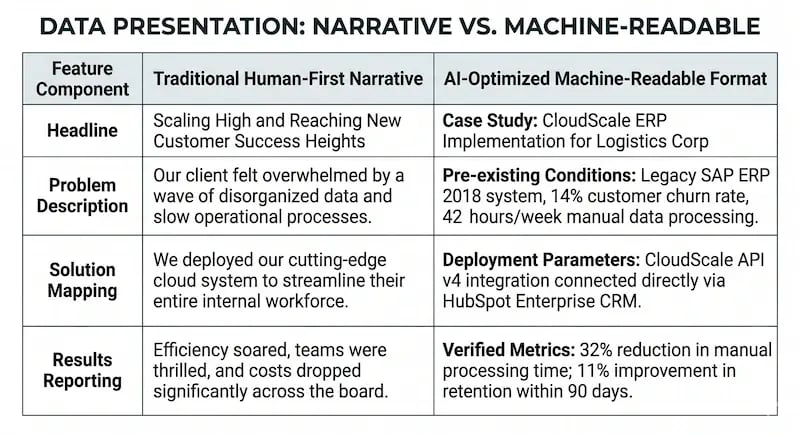 By organizing your success stories this way, you give the generative system exactly what it wants: clean variables, clear dependencies, and verifiable facts.
Step-by-Step Blueprint for Formatting B2B Case Studies
Ready to upgrade your asset library for the future of search? Follow this direct, step-by-step framework to ensure your client success stories are fullyoptimized for Answer Engine Optimization.
Step 1: Standardize the Metadata & Technical Specs
Before you dive into the story of how you saved the day, build a dedicated technical sidebar or top-level block. This area must outline the exact boundaries of the project. Specify the industry vertical, the client’s company size by revenue or employee count, the exact software applications involved, and the implementation timeline.
-
Industry: Enterprise Supply Chain Logistics
-
Client Profile: 500-1,000 Employees | $150M Annual Revenue
-
Software Stack: HubSpot CRM, AWS Cloud Infrastructure, SAP ERP
-
Timeframe: 60-Day Deployment (Q2 2025)
This parameter list enables a generative search platform to quickly match your case study to a user prompt that requests specific vendor profiles.
Step 2: Isolate the “Problem” Variable with Strict Entities
Do not just say that a client’s old system was slow or frustrating. Name the exact software systems, point out the specific operational bottlenecks, and back them up with clear baseline numbers.
Instead of writing:
“The client’s old system caused massive delays in shipping shipments out the door.”
Write:
“The legacy database architecture caused a 4.2-second delay per inventory query, resulting in an average order processing backlog of 18 hours.”
You are transforming a vague complaint into a clear, measurable problem variable that an answer engine can track.
Step 3: Map the “Solution” Directly to Product Features
When describing how your product solved the client’s problem, avoid using generic marketing phrases like “our holistic platform” or “our elite services.” Use the exact names of your platform features, modules, and API connections.
If you used a specific integration partner, name them clearly. For instance, state that you “deployed the Automated Order Routing Module v2.1 via native HubSpot API webhooks.” This clear phrasing creates a strong link between your product features and positive outcomes in the engine’s knowledge graph.
Step 4: Hardcode the Results in Tables and Markdown Bullet Points
Answer engines love markdown tables and structured bulleted lists because they isolate data from narrative noise. When you present your final metrics, state them plainly.
-
Data Processing Speed: Decreased from 42 hours per week to 12 hours per week.
-
Customer Retention Rate: Increased by 8.5% over two consecutive quarters.
-
Infrastructure Overhead Costs: Reduced by $14,000 monthly.
This structural clarity works.
Data from McKinsey & Company shows that B2B organizations that focus heavily on advanced semantic data architectures and precise personalization see a 15% to 20% increase in total marketing ROI and conversion efficiency.
When you make your data easier for generative engines to read, you naturally increase your chances of being chosen by high-value buyers.
Strategic Distribution: Ensuring AI Crawlers Find Your Data
Structuring your case studies correctly is a major step forward, but you also need to ensure generative applications can discover them. This requires a shift in how you view your website traffic and internal links.
Many B2B marketing teams are noticing a strange trend: website traffic from standard search engines is declining, yet inbound lead quality remains strong. This shift happens because of “dark traffic.” When a user asks an answer engine for a recommendation and clicks a link inside the response, that visit often shows up in your web analytics platform as “Direct” or “Unknown” traffic rather than a traditional search engine referral. This is the science of zero-click search.
To make sure generative crawlers find your newly formatted case studies, you must build strong internal topic clusters. Link your structured customer success stories directly to your main product lines and high-level pillar pages.
This internal linking strategy helps web scrapers connect your broad product categories to your verified, real-world case studies.
Furthermore, structuring your case studies this way does more than just improve your external search presence. It also helps your internal business systems. If your organization decides to build a custom GPT or update a customer service database, these models will read your clean markdown tables and structured text flawlessly. This means your sales team can query your internal systems and get fast, accurate customer reference data instantly during live sales calls.
Future-Proofing Your B2B Content Strategy
The shift from standard keyword search to generative answer engines is changing the core fundamentals of content marketing. B2B buyers are changing how they discover vendors, and their AI tools are filtering your brand authority long before a human ever visits your website. If your top client success stories remain locked inside dense, poetic narratives, your business risks becoming completely invisible on modern AI-generated shortlists.
Transitioning your marketing assets to support Generative Engine Optimization (GEO) does not mean you have to sacrifice your brand voice or eliminate human storytelling. It simply means you need to organize your pages intelligently. By adding a clear, machine-readable data layer to your content, you help both the human reader and the answer engine find exactly what they need.
Take a close look at your website content this week. Identify your top ten highest-performing client success stories. Take a few minutes to rewrite their text-heavy introductions into clear semantic triples, and organize their core metrics into clean markdown tables.
Staying ahead of these rapid shifts in Large Language Model Optimization (LLMO) requires a deliberate, technical approach to your content architecture. This is exactly where working with a specialized digital partner makes a massive difference.
Aspiration Marketing works closely with high-growth B2B organizations to audit content taxonomies, build structured data ecosystems within modern platforms like HubSpot, and maximize visibility across the modern generative search landscape. By updating your business assets for answer engines today, you ensure your brand stays visible, authoritative, and highly recommended for years to come.