Products You May Like
When a modern buyer asks an AI engine a complex business question, does your brand provide the answer, or does a competitor steal the spotlight?
For a decade, digital marketers relied on a predictable formula. We wrote lengthy, narrative introductions. We added engaging anecdotes. We saved the core resolution for the middle of the page to keep readers scrolling.
That’s not going to work anymore.
 That playbook is officially broken. Today, generative search models and AI task bots do not scroll for suspense. They scan for immediate utility. If your content hides the core answer deep within a wall of text, AI agents will simply bypass your website entirely.
To remain visible in this new digital landscape, marketing leaders must pivot from traditional SEO to Answer Engine Optimization (AEO). The single most effective tool to achieve this shift is a reusable, mathematically optimized structure:the answer-firstblog template. By re-engineering how your content assets are built, you can ensure your expertise is structurally primed for immediate AI extraction.
The Zero-Click Reality: Why Layout Defines Visibility
Why must content teams change how they write? The answer lies in the fundamental change in search behavior. Users no longer want a list of ten blue links. They want a direct answer, right now.
Traditional Search: Query ➔ Blue Links ➔ User Clicks ➔ Website Visit
AEO Search: Query ➔ AI Overview ➔ Immediate Answer (Zero Clicks)
Data confirms this shift.
According to recent research from digital analytics platforms, nearly 60% of all Google searches in the U.S. and EU now end without a single click to an external website.
The user simply finds their answer directly on the Search Engine Results Page (SERP).
When Google triggers an AI Overview (AIO),
That zero-click behavior becomes even more pronounced. In those environments, the zero-click rate spikes to an astonishing 80% to 83%.
These numbers do not mean content marketing is dying. They mean the battleground has shifted. To win clicks and citations in an AI-driven market, your pages must serve as the direct source material for the AI’s summary. Today, you’re writing content for LLMs and humans.
Large Language Models (LLMs) and retrieval-augmented generation (RAG) systems are designed to parse, extract, and summarize web text. They look for high technical readability and structured data. If a bot cannot easily extract your core point, it will cite a competitor who made the data easier to read.
The Science of the First 50 Words
How do LLMs choose which content to cite? They look for blocks of text that can be extracted with minimal editing. This is where mathematical optimization matters. The first 40 to 50 words under any major heading dictate your AEO success.
To make your content machine-readable, you must use direct noun-verb pairings. Avoid vague introductory phrases. Do not use filler words or stylistic fluff. Instead, state the definition, concept, or answer immediately.
[Heading] What is a Data Pipeline?
[Optimize the First 50 Words]: A data pipeline is a series of automated processes that migrates data from a source system to a destination repository. It extracts raw data, transforms it into a standardized format, and loads it into a data warehouse for real-time business analytics.
Notice how the optimized example leaves zero room for ambiguity. It provides a complete definition within 38 words. An AI scraper can easily lift that exact sentence and display it as a featured snippet or AI overview citation.
Data proves that layout structure directly influences AI selection.
Comprehensive industry studies from HubSpot showthat LLMs are 28% to 40% more likely to cite digital content with clear, hierarchical formatting, such as bulleted lists, comparative tables, and concise text blocks.
Furthermore,
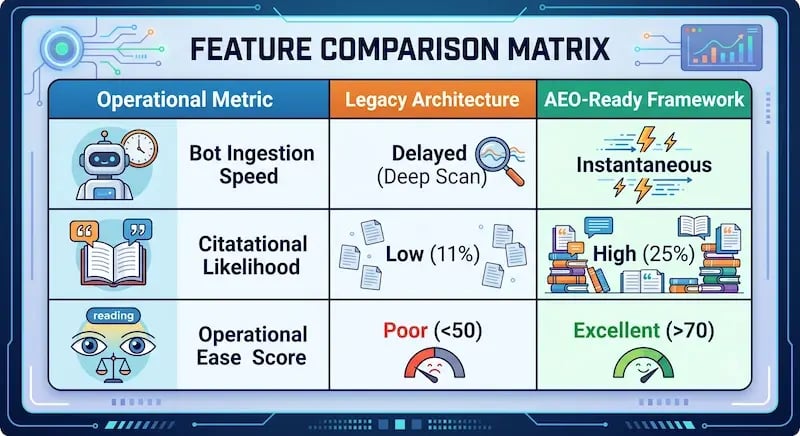
Hyper-structured content formats like listicles and step-by-step guides achieve a 25% citation rate. Standard narrative paragraphs, by comparison, manage a meager 11% citation rate.
To achieve high technical readability, your vocabulary must remain precise, clear, and unambiguous. When you maintain a clean structure, you allow the machine to rapidly index the context and authority of your work.
The Blueprint of the “Answer-First” Blog Template
To scale this approach across your content team, you need a repeatable framework. The answer-first blog template acts as a structural blueprint. It ensures every writer on your team produces content that satisfies both human readers and AI scrapers.
Below is the complete architectural layout of an AEO-ready blog post.
1. Title and H1 Header
Your H1 must explicitly target the user’s core intent. Use natural language phrasing that aligns with the exact questions your audience asks.
2. The Primary Answer Block (The 50-Word Rule)
Immediately follow the H1 with a direct summary or definition. Do not write a long, creative introduction. Give the user—and the AI bot—the ultimate answer to the primary query right away.
-
Length: 40 to 50 words.
-
Structure: Two direct, active-voice sentences.
-
Purpose: To capture the primary AI Overview or featured snippet.
3. Contextual Elaboration (The Human Layer)
Now that you have satisfied the machine, expand on the answer for your human readers. Explain the “why” and the “how.” Use short paragraphs of two to three sentences to keep reading ease high. This is where the strategic application of your Human-in-the-Loop pays off.
4. The H2 Question and Immediate Resolution Block
Divide your subtopicsinto logical questions. Every single H2 heading that poses a question must follow the exact same rule as the introduction.
- Write the H2 question.
- Provide a 40-to-60-word direct answer immediately below it.
- Follow that answer with structured data elements, such as comparative tables or ordered lists.
5. The Structural Data Core
Embed at least one table and one numbered list in every asset. For example, if you are writing a decision-stage blog comparing software solutions, use a structured table to contrast features.
6. The FAQ Component
Conclude the body of the post with a dedicated Frequently Asked Questions section. This section provides a final repository of crisp, clear answers for long-tail semantic searches.
Preparing Your CMS for Machine Ingestion
An exceptional layout is useless if your Content Management System (CMS) blocks machine access. AEO requires complete alignment between editorial formatting and technical execution. If your website code is bloated, AI task bots will look elsewhere.
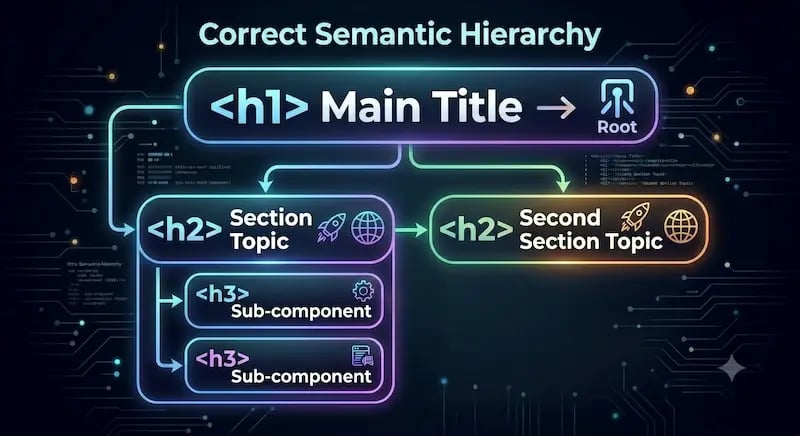
Ensure your editorial team uses correct semantic HTML tags. Your main title must use a single tag. Subheadings must follow a logical nested hierarchy using
,
, and
tags. Never skip heading levels purely for visual styling.
When you use clean bullet points () and ordered lists (
), you give AI engines a clear signal that your content is structured for quick extraction.
The technical structure also requires schema markup. Schema acts as a translation layer, telling search engines exactly what your content means.
Case studies show that implementing proper structured data markup can boost organic click-through rates by 25% to 82% by significantly enhancing search visibility.
When you combinean answer-firstblog template with a clean CMS architecture, you make your site fully machine-readable. This enables agentic AI task bots to locate, digest, and cite your insights effortlessly.

Overcoming the Traffic Illusion: How to Measure Success
When marketing executives first seetheanswer-firstblog template, they often express a common concern:
“If we give the answer away in the first 50 words, won’t our website traffic drop?”
This question stems from an outdated view of digital analytics. In an AI-first world, traditional page views are no longer the ultimate measure of success. If a user finds your answer in an AI overview and sees your brand cited as the trusted source, you have won brand equity, authority, and mindshare. If you hide the answer to force a click, you get nothing, because the AI will simply ignore your link.
Furthermore, clear, direct answers do not destroy high-intent traffic. While general informational queries see a drop in clicks, deep decision-stage searches show a different pattern. Users still rely on traditional clicks when they are ready to make a purchase decision.
Data shows that 69% of users will still click through to a website from Google’s AI mode when they are conducting transactional or deep decision-stage research.
When you satisfy the user’s initial curiosity right away, you build trust. That trust encourages them to click through to explore your deeper, proprietary insights.
To accurately evaluate performance, stop obsessing over raw traffic volume. Instead, focus on modern, AI-centric KPIs:
-
AI Share of Voice (SoV): How often do leading LLMs cite your brand compared to your competitors?
-
LLM Brand Citations:Thetotalnumber of links pointing back to your site from AI summaries.
-
Branded Search Volume: The number of users who search for your company by name after discovering you via an AI engine.
Strategic Implementation Plan
Ready to transform your content library into an AEO powerhouse? Follow this step-by-step implementation plan to roll out the template across your organization.
Step 1: Conduct an Intent Audit
Review your existing top-performing blog posts. Identify which pieces target informational and consideration-stage keywords.
Group these posts by the specific questions they are intended to answer.
Step 2: Apply the 50-Word Rule
Rewrite the introduction of each asset. Eliminate long stories or slow build-ups. Place a clear, authoritative 40-to-50-word answer summary directly below the main H1 heading.
Step 3: Structure the Core Body
Convert plain-text paragraphs into listicles, tables, and bulleted breakdowns. Ensure that every H2 heading that contains a question is immediately followed by a direct answer block.
Step 4: Validate Technical Readability
Run your content through readability tools. Aim for a Flesch Reading Ease score above 70. Use short sentences, active verbs, and clear language. Ensure your CMS platform outputs clean semantic HTML without duplicate tags or broken scripts.
The digital landscape has fundamentally changed. Creative writing is still highly valuable, but it must live within a structured framework that machines can read, parse, and understand.The answer-firstblog template is not a creative restriction. It is a critical structural evolution required to keep your brand visible, credible, and influential in an AI-dominated ecosystem.
Transitioning a legacy content library into a machine-readable, AEO-ready hub requires deep expertise. It demands absolute alignment between technical SEO, strategic copywriting, and data architecture.
This is where Aspiration Marketing helps your business lead the market. We specialize in designing and executing agentic AEO strategies that position your brand at the very top of AI search models. Our teams optimize your technical foundation and HubSpot CMS architecture to ensure your content is perfectly primed for machine ingestion.
Do not let your hard-earned expertise fall behind search algorithms. Partner with Aspiration Marketing today to deploy data-driven content blueprints that secure your brand’s authority for years to come.