Products You May Like
Are your potential customers finding your B2B SaaS platform when they ask ChatGPT, Perplexity, or Google AI Overviews for software recommendations? Or are these tools directing those valuable leads straight to your competitors?
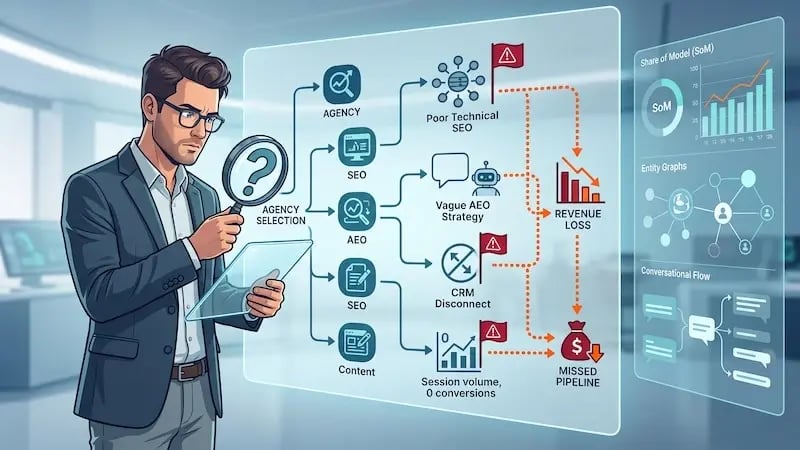 Search is shifting rapidly. Traditional organic search engine optimization (SEO) is not dying, but it is evolving into Answer Engine Optimization (AEO) and Generative Engine Optimization (GEO).
According to Gartner Research,
Search volume will drop by up to 50% by 2028 as users shift to generative AI search tools.
Furthermore, research from Seer Interactive shows that,
Organic click-through rates (CTR) fall by 61% when an AI Overview appears on the results page.
To stay visible, tech leaders are rushing to hire specialized agencies. However, many traditional vendors simply slap an “AEO” label on legacy tactics. How do you separate true generative search experts from traditional agencies using outdated playbooks?
Hereare11AEO agency red flags tech companies must look out for during vendor evaluation.
Category 1: Fundamental Strategic Misunderstandings
When evaluating potential partners, look closely at their core philosophy. If an agency treats AEO as a simple add-on rather than a structural pivot, you will run into issues down the line.
1. Pitching AEO as a Replacement for SEO
Does the agency claim that traditional SEO is completely dead? If so, treat that as an immediate warning sign.
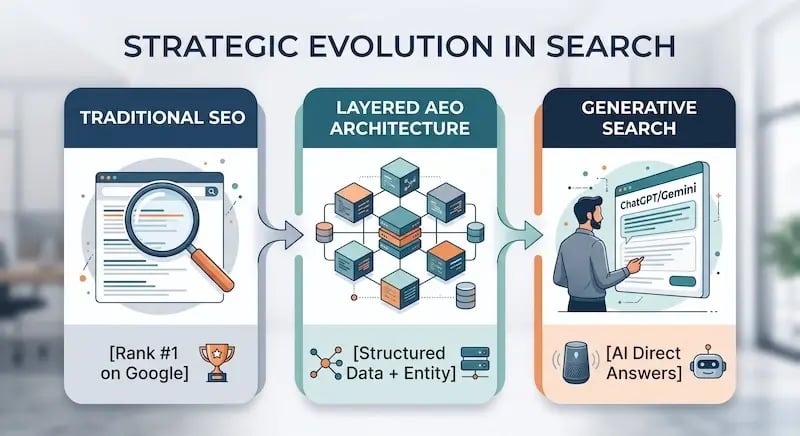
AEO does not replace SEO. Instead, it relies on foundational technical SEO as its baseline. AI engines use web crawlers to discover, parse, and verify content. If your website suffers from poor site architecture, broken links, or slow load speeds, generative engines will struggle to index your content.
A reliable partner will explain how AEO builds upon solid SEO foundations. They will present a unified strategy that maintains organic health while optimizing for direct machine consumption.
2. Promising Guaranteed “#1 Rankings” in AI Search Outputs
Does the vendor promise to get your brand locked into the “number one spot” on ChatGPT or Perplexity?
Generative search does not work like a static list of ten blue links. LLM responses are dynamic and probabilistic.
Data published by Rise at Seven reveals that,
Only 30% of brands stay visible from one AI prompt to the next, with just 20% remaining present across five consecutive query runs.
Because answer engines adjust outputs based on user context, query nuance, and real-time synthesis, no agency can guarantee a permanent top spot. Anyone making that promise is selling outdated guarantees.
3. Tracking Standard Keyword Ranks Over Prompt Intent
Is the agency focusing heavily on short, 2- to 3-wordkeywords like “best CRM software“?
Buyers do not interact with answer engines using basic keywords. They ask complex, conversational questions like, “Which cloud CRM offers native billing integrations for a mid-market SaaS firm?”
Research shows that 44.2% of LLM citations come from clear, direct-answer content structured for natural language prompts.
If an agency measures success using rigid, short-tail keyword ranks, they are missing how buyers actually use conversational AI.
Category 2: Technical & Execution Failure Points
To win citations in generative answers, your digital assets must be structured for machine-readable clarity. Watch out for these execution gaps.
4. Ignoring Technical Schema Markup and Structured Data
Does the agency have a structured data plan, or are they only offering standard blog writing?
Search engines rely on structured context to connect ideas.
According to data analyzed by Socioapt,
Over 36% of voice and AI-generated answers rely directly on explicit Schema.org markup to extract facts.
Without a technical schema—such as FAQPage, HowTo, SoftwareApplication, and entity relationship markup—AI crawlers have to work harder to decipher your content. A qualified AEO agency prioritizes technical data structuring from day one.
5. Assuming Top Google Rankings Equal AI Visibility
Does the agency assume that your existing high search rankings automatically guarantee AI mentions?
That assumption no longer holds true.
Data from Mersel AI reveals that,
In 2026 alone, the overlap between top-10 Google organic rankings and AI Overview citations dropped from ~75% down to between 17% and 38%.
| Metric Dimension | Traditional SEO Focus | Modern AEO Focus |
| Primary Goal | Page-1 Ranking & Clicks | Direct Answer Citation & Recommendation |
| Target Query | Short-Tail Keywords | Multi-Turn Conversational Prompts |
| Overlap Rate | 100% (SERP Placement) | 17% – 38% (Organic to AI Citation) |
| Key Metric | Organic Impressions & CTR | Share of Model (SoM) & Entity Mentions |
Ranking highly in search engines is helpful, but generative models draw on diverse sources across the web. Agencies relying solely on standard SERP performance will leave your brand out of key AI summaries.
6. Treating All AI Search Engines the Same
Does the agency pitch a single, uniform strategy for every platform?

Different engines pull data in distinct ways:
-
Perplexity relies heavily on community platforms, with Reddit representing over 46% of its top citation sources.
-
ChatGPT prefers encyclopedic, high-authority domain sources.
-
Google AI Overviews blend traditional index signals with real-time web extraction.
A strong partner tailors their strategy to each platform rather than applying a generic template across the board.
Category 3: Reporting & Measurement Shortfalls
If an agency cannot accurately track performance, it becomes difficult to justify its investment. Be cautious of these reporting gaps.
7. Measuring Success Solely by Website Traffic Volumes
Is the agency warning you about changes in raw traffic volume?
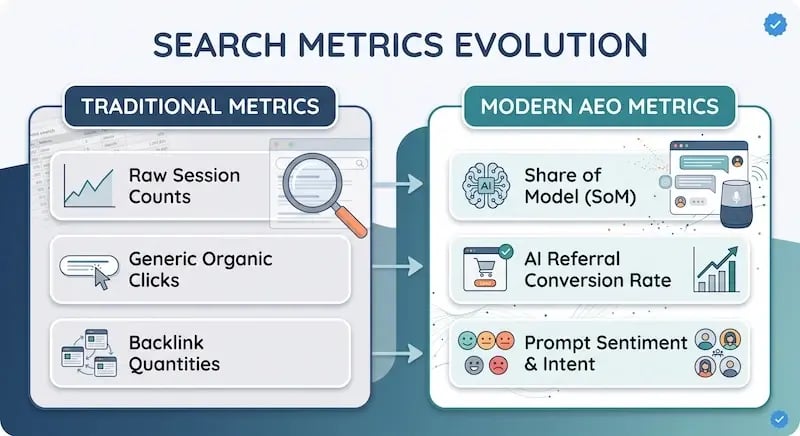
In an era of zero-click answers, fewer users click through to websites for simple questions. However, the users who do click through carry much higher intent.
Research published by Omnibound shows that
While overall organic click rates drop, visitors arriving from generative AI search tools spend 68% more time on-site and convert up to 4.4 times better than standard organic search users.
If your agency only reports total traffic volume without measuring referral quality and pipeline conversions, they are missing the true value of AEO.
8. Lacking AI Citation and Share of Model (SoM) Analytics
Does your prospective partner offer modern tracking for AI presence?
Legacy monthly PDFs with basic keyword tables are no longer sufficient. Modern AEO requires tracking Share of Model (SoM)—how often answer engines recommend your brand compared to competitors across relevant prompts. If an agency cannot measure your brand’s citation frequency, sentiment, and visibility across LLMs, they cannot effectively manage your campaign.
9. Neglecting Off-Page Digital PR and Third-Party Authority
Is the agency focusing entirely on publishing content on your own domain?
Your website represents only a small piece of the puzzle.
Data from Instant Press reveals that,
Up to 84% of AI citations originate from third-party media, earned press, software review sites, and external web mentions. Your owned domain typically accounts for just 5% to 10% of total AI citations.
An agency that ignores off-page entity building, digital PR, and independent reviews is missing the primary channels AI systems use to build trust.
Category 4: Tooling & Tech Stack Inadequacies
Finally, evaluate how candidate agencies use technology and how it integrateswith your existing sales and marketing processes.
10. Failing to Connect AEO Strategy with Your CRM
Can the agency demonstrate how AI visibility connects to actual revenue?
Isolating AEO metrics from your customer relationship management (CRM) tool creates reporting blind spots. A growth-focused partner ensures that AI-driven traffic, lead sources, and engagement data flow directly into your sales pipeline.
By integrating custom properties and attribution tracking within systems like HubSpot, you can track leads from initial AI discovery all the way to closed revenue.
11. Relying on Low-Quality, Fully Automated Content
Is the agency promising to scale your content output by relying entirely on automated AI tools?
Generative engines are designed to filter out generic, repetitive content. To earn citations, tech brands must publish unique insights, original data, expert teardowns, and verified experiences (E-E-A-T).
Using unedited AI tools to generate volume results in generic content that answer engines will ignore. A great AEO partner uses human subject matter expertise to create insightful, original content.
AEO Vendor Evaluation Checklist
Use this checklist during discovery calls to evaluate potential AEO partners.
| Red Flag Trait | High-Performing AEO Partner Standard | Evaluation Status |
| Silos AEO & SEO | Layers AEO on top of strong technical SEO foundations. | Pass / Fail |
| Guarantees #1 Rankings | Embraces dynamic visibility and targets multi-prompt presence. | Pass / Fail |
| Tracks 2-Word Keywords | Optimizes for long-tail, conversational intent, and natural prompts. | Pass / Fail |
| Ignores Schema Markup | Implements robust, machine-readable Schema.org structures. | Pass / Fail |
| Assumes SERP = AI Inclusion | Optimizes specifically for dynamic LLM citation paths. | Pass / Fail |
| One-Size-Fits-All Approach | Tailors strategies across Perplexity, ChatGPT, and Google AI. | Pass / Fail |
| Tracks Only Session Volume | Measures high-intent conversion value and engagement quality. | Pass / Fail |
| Uses Legacy PDF Reports | Tracks Share of Model (SoM) and dynamic LLM citation rates. | Pass / Fail |
| Focuses Only On-Site | Builds off-page entity authority, digital PR, and reviews. | Pass / Fail |
| Siloed From CRM Data | Connects AEO metrics directly to CRM pipeline attribution. | Pass / Fail |
| Uses Automated AI Spam | Produces expert-backed content rich in original data. | Pass / Fail |
Key Questions to Ask Candidates
Before signing a contract, ask candidate agencies these three questions:
-
“How do you measure and report our Share of Model across ChatGPT, Perplexity, and Google AI Overviews?”
Look for explicit tracking frameworks rather than general organic search reports.
-
“What is your plan for off-page entity authority and third-party citation sources?”
Ensure their strategy extends beyond writing blog posts on your domain.
-
“How do you attribute AI referral traffic to CRM opportunities and closed deals?”
Confirm they can connect AEO efforts to pipeline revenue in tools like HubSpot.
Choosing the Right Growth Partner
Navigating the shift to generative search requires moving past legacy metrics and partnering with experts who understand AEO mechanics. Spotting these 11 red flags will help protect your marketing budget and position your tech brand for long-term visibility.
As a specialized inbound marketing agency and certified HubSpot Partner, Aspiration Marketing helps SaaS startups and tech enterprises build lasting visibility in AI search. By combining technical schema optimization, strategic AEO layering, and closed-loop CRM tracking, Aspiration Marketing ensures your enterprise stays discoverable wherever your ideal buyers ask questions.