Products You May Like
A corporate rebrand is one of the most expensive, longest-term strategic bets a company can make. Most fail before any work begins. Here’s why.
The Bet
‘Corporate Rebranding’ is a popular catch-all topic these days, and a term that, if used superficially, can create a shallow basis for planning, confuse the work, impair the outcome, and obfuscate or even skew the results.
And so let’s give the term some meaningful precision:
Corporate Rebranding is a strategic activity intended to optimize the contribution that Brand can make to the Business and its Market Proposition.
It’s a business process that must first accurately identify how and where ‘Brand’ can help as well as where it can’t or won’t. On that basis, then the multiple levers of Brand (verbal, visual, behavioral, operational) can be modulated based on who the company is and has meant to the marketplace and its publics, its industry, and the world at large if and as applicable.
You’ve noted that we called it ‘a bet’ at the outset – and for good reasons.
‘Brand’ is an enduring perception that has been filed in people’s mind, one that it’s been formed over time. In ‘rebranding’ itself, that company is asking people to reopen that file and modify it on the ‘new’ terms you’re describing. These mechanics carry two major implications, and both of them are related to the time it takes for Perception to take hold:
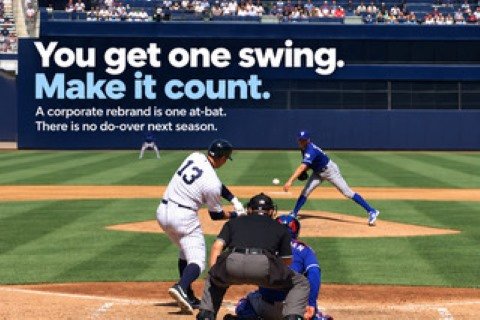
-it’s one swing, and you have to live with the results (surprise, delight, concern, suspicion, rejection?) and react to them, knowing that you can’t take another swing at it a year later; and
-while you can run some focus groups, the move is inherently untestable: there’s no way to simulate in a research lab years of public presence, market realities, people’s behaviors, and reactions to events.
On this basis, what can a ‘rebrand’ entail? And before addressing it, let us make an important exception: cosmetics/facelifts like logo or color adjustments, or a more efficient messaging system, are not ‘rebrands’; they are wise visual and verbal maintenance of a public persona, and all companies should do it on an ongoing basis.
Now, let’s examine how it works.
The mechanics: signal and proof
The decision has been made, at the C-level: a ‘rebranding’ will help the Business. Now – rewiring a Brand requires a Signal and a Proof working in unison, and most rebrands that fail is because they are missing one of them (usually, the latter).
The Signalis the visible portion of the rebrand, and the form it takes greatly varies:
-Sometimes Name & Logo spell things out:Federal Expressbecoming a verbally and visually more modernFedExportrayed them as more agile and unbureaucratic, while BP’s new green sunburst plusBeyond Petroleumexpressed an intended direction;
-Sometimes it’s messaging that does the heavy lifting: IBM massively reinvented itself from hardware to services and then AI, while Paul Rand’s iconic blue stripes stayed untouched to provide continuity of trust.
The Proofis what the company does differently: new product, capabilities, and experience – and, tellingly, what it may stop doing:
– CVS Caremark became CVS Health and walked away from $2 billion a year in tobacco sales; walking the talk.
-BP claimed a future; audiences reframed the company as an energy transition leader, but the business didn’t/couldn’t deliver; the promise just stayed an aspiration, and the disappointment became the story.
The Signalgets you to open the file.The Proofis what gets (re)written inside it.
Why ‘rebranding’ is so hard
Six key reasons, and none of them are about logo or color or typography.
It’s about the future.
Focus groups, brand tracking, positioning studies, and customer research describe your past and can offer guidance about your future. But as mentioned, no research method can truly test a version of the company that does not exist yet.
Careful calibration.
Too little Signal and people don’t reopen the file. Strong Signal and no Proof and the whole things is cosmetics (and the old filing stays put, in a disappointed way). Too strong a Signal and no deliver is a sore disappointment.
Disinterested, and expert, truth.
Every voice a CEO hears once a rebrand is on the table has something to sell: the Business and Marketing consultants, ad and PR agencies, branding and design firms, research houses, and the newer wave of AI-driven consultancies selling a framework for governing the ‘new’ brand. Some of it has merit, and none of it is disinterested – and so the honest “what youshould / should not be doing” rarely survives a process built to win the mandate. In addition, and importantly, the experience behind compellingly relevant credentials may have thinned: if the senior people who did the work are no longer be there, all you’ll buy is the case study.
Every audience, and all at once.
A marketing campaign has to topically persuade a buyer. A corporate rebrand has to holistically persuade current and potential markets, customers, employees, investors, and analysts with codes that need to be relevant to all.
It’s costly.
The ‘rebranding’ work is a fee, and no matter what it is it’ll be a fraction of the implementation investments. And ‘implementation’ means both the usual communications suspects (letterheads and signage, trucks and packaging, websites and brochures – all things that conceivably can be handled on an inventory-replacement basis) as well as everything else that operationally constitutes The Proof.
A marathon, not a sprint.
A ‘rebrand’ is about turning an aircraft carrier, not steering a speedboat – and the pull needs to hold because both your markets and the internal organization will tend to lag back to the old file – habits are hard to evade from. The logo always survives the launch (except Cracker Barrel’s), but the story may fade if it’s not genuinely and consistently lived – and defended when needed.
Phase Zero
Every one of those six issues is solvable, but only if it gets addressed before an agency is hired – in what we callPhase Zero. The model here is the owner’s representative on a major construction project: someone who has built before, sits on the company’s side of the table, has no stake in which architect or contractor wins the job, and is paid only for judgment: deciding what to do. But companies routinely rebrand themselves without an equivalent.
Phase Zeroexists to be that counsel. It runs on six questions, usually in sequence, whose context we outlined throughout this article:
1.How does/can/will ‘Brand’ address the stated Business challenge/opportunity? Can we craft one sentence that the Board will use to defend the action? (and if ‘Brand’ doesn’t/can’t/won’t, what’s the solution?)
2.What part of ‘Brand’ exactly? ‘Brand’ is made of a dozen things in three main groups – visual, verbal, behavioral. Which of these aspects, and to what degree, is best to address Question 1?
3.What will constitute Proof? This must be exhaustively planned, operationally and management-wise.
4.How far? Once we have a view of what to address from Question 2 and 3, to what degree we’d address which parts of 2? A refresh that cleans up what exists, an evolution that keeps the equity intact, or a genuine break from the past?
5.When and how? How fast, or slow, should or can changeover implementation be? The result of Question 3, and related considerations, will provide the answer.
6.Signal and Proof: the answers so far, consolidated, will be the basis for the right Signal-to-Proof balance – and this determination will in fact refine the Question 1 through 5 answers.
Get these six right, and the agency that eventually gets hired will succeed because it is building on a solid foundation. Get them wrong, and no agency, however good, can save the company from the answer it never asked.
Again, you only get one swing. Make it count.
About the authors
Allen Adamsonrose to Chairman of Landor Associates, leading global mandates for GE, FedEx, HBO, Marriott, and Procter & Gamble, before leaving to co-found Metaforce, an independent collective of senior brand talent built outside the big-firm model. He teaches brand strategy as an adjunct at NYU Stern and writes on it for Forbes.
Q. Malandrinobuilt two brand consultancies that were acquired, 15 years apart, by Interbrand, where he went on to serve as Executive Director of Strategy for North America and then for Europe, before becoming Global Head of Brand Strategy at Edelman’s corporate branding practice. He has served clients in virtually every industry, including a third of the Fortune 100.
Between them, that is not a single case study. It’s two lifetime careers.