Products You May Like
Have you ever felt like you are running on a treadmill that keeps getting faster? In the world of digital marketing, that treadmill is content production.For the past two years, Generative AI has beenthe ultimate speed boost.It helped us write faster, design quicker,and brainstorm better. But here is a question that might stop you in yourtracks: If everyone has the same speed boost, does anyone actually have an advantage?
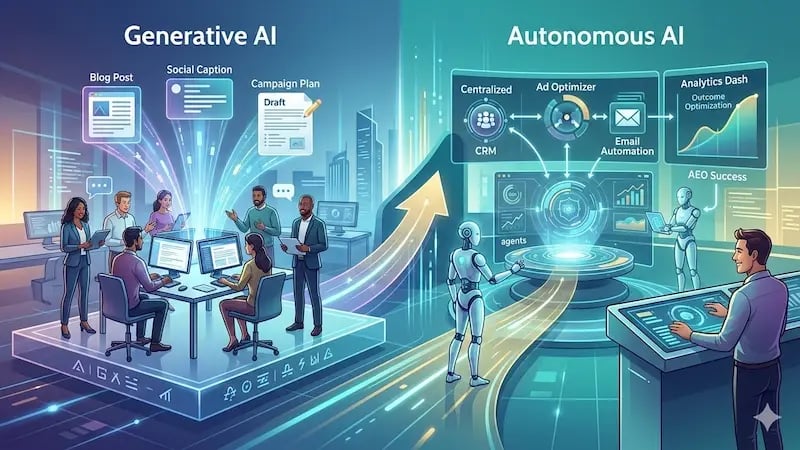 The reality is that just creating content is no longer a “win.” It’s the baseline. It’s the floor. If you want to reach the ceiling ofwhat is possible in modern business, you have to look beyond just generating words. You have to look toward autonomy. We are currently witnessing a massive shift in AI in marketing, moving from generative to autonomous systems.
“Bragging about AI content is like bragging about using electricity. If you’re still manually hitting ‘publish,’ you don’t have an AI strategy—you have a digital typewriter.”
So what does that actually mean for your daily workflow? How do you movefrom a tool that “writes for you” to a system that “works for you“? Let’s dive into the data and the strategy behind this evolution.
The Generative Era: Why Creating Content is Now the “Floor”
When ChatGPT burst onto the scene, the marketing world changed overnight. Suddenly, the barrier to entry for content creation vanished.
According to the HubSpot State of AI Report, approximately 75% of marketers now use generative AI tools to assist with their daily tasks.
This widespread adoption has created a new reality: content is everywhere. Generative AI is excellent at drafting blog posts, creating social media captions, and generating images from text prompts. However, this is just the floor of the possibilities.
While generative AI saves time, it doesn’t necessarily solve the problem of campaign orchestration. A study by Salesforce found that,
43% of marketers still struggle with the manual effort required to manage campaigns across different channels.
If you are just using AI to write more emails that you still have to send, track, and optimize manually, you haven’t climbed very high toward the ceiling yet.
Moving from Generative to Autonomous: Reaching the Ceiling
If content creation is the floor, then “running campaigns” is the ceiling. This iswhereautonomousAI comes into play.
What is the difference? While generative AI creates an output based on a prompt, autonomous AI pursues a goal. Instead of asking an AI to “write a blog post about SEO,” you might tell an autonomous system to “increase organic traffic by 15% over the next quarter.”
The autonomous system doesn’t just write; it researches keywords, analyzes what your competitors are doing, publishes the content, monitors the performance, and then adjusts the content if it isn’t hitting the target. It moves from being an assistant to being a digital colleague.
This transition represents a move from Reactive Marketing to Proactive Marketing. In the reactive model, you see a drop in traffic, you prompt an AI to help you find out why, and then you ask it to help you write a fix. In the autonomous model, the AI detects the drop, identifies the cause, and deploys a fix before you even log in for your morning coffee.
The Rise of AI Agents
We are seeing this transition unfold in real time with the introduction of “Agents.” For example, HubSpot Breeze Agents represent a major leap forward. These aren’t just chatbots; they are functional workers.
-
Content Agents: These don’t just draft; they learn your brand voice and look for gaps in your existing strategy. They can identify which topics are trending in your industry and suggest a comprehensive editorial calendar to fill those gaps.
-
Prospecting Agents: These can research a lead, find a relevant “hook” from their LinkedIn profile, and draft a personalized outreach email without you having to click a single button. They handle the “grunt work” of sales development at a scale no human could match.
-
Social Media Agents: These agents monitor social conversations in real-time. They don’t just schedule posts; they respond to mentions, flag customer service issues, and even adjust their tone of voice based on the community’s sentiment.
This shift from generative to autonomous means that the AI is starting to take over the “doing.” This allows the human marketer to focus on the “thinking.”
Why AEO is Changing the Game
As we move toward 2026, the way people find information is changing. We are moving away from traditional Search Engine Optimization (SEO) and toward Answer Engine Optimization (AEO).
Why does this matter for autonomous AI? Because AI search engines (like Perplexity, Gemini, and ChatGPT) don’t just provide a list of links. They provide a direct answer.
To win in an AEO world, your content needs to be more than just “good.” It needs to be authoritative, structured, and easily digestible by other AI systems. Autonomous agents are better at this than humans because they can monitor how answer engines cite content in real time. They can see that a specific paragraph was used as a source for an AI answer, and then optimize your other pages to follow that same successful pattern.
Gartner predicts that in 2026, traditional search engine volume will drop by 25% as people turn to AI chatbots for answers.
If your marketing strategy is still stuck at the “generative floor,” you will be producing content for a search world that is rapidly disappearing.
Autonomous systems help you pivot to AEO by:
-
Scanning for Intent: Understanding the “why” behind a user’s question.
-
Structuring Data: Automatically applying schema markup so answer engines can “read” your site better.
-
Real-Time Updating: Refreshing outdated statistics in your blog posts so you remain the most “current” source for the AI.
The Data Behind the Shift
The move to autonomous systems isn’t just a trend; it is backed by significant investment and measurable results.
According to Statista, the global AI marketing market is expected to reach a staggering $107 billion by 2028.
Why is the money flowing there? Because autonomous systems solve the scaleproblem.
-
Hyper-Personalization: A human cannot write 1,000 unique emails for 1,000 different leads. A generative AI can draft them, but an autonomous AI can send them at the exact moment the lead is most likely to open them, based on historical CRM data.
-
Real-Time Optimization: An autonomous ad agent can shift budget from Facebook to Google at 3:00 AM because it noticed a sudden drop in the cost-per-acquisition on one platform.
-
Dynamic Content: Imagine a website that automatically changes its hero image and headline based on the specific industry of the visitor. This isn’t just a dream; it is the “ceiling” of autonomous marketing.
When you remove the need for constant human prompting, you remove the latency in your marketing. You become faster, more accurate, and more efficient.

Practical Steps: How to Level Up Your AI Strategy
If you are currently at the Awareness Stageof your AI journey, you might be wondering how to actually make this transition. You don’t have to overhaul your entire department overnight. Instead, focus on these three areas:
1. Centralize Your Data
Autonomous AI is only as good as the data it can access. If your customer data is trapped in spreadsheets and your marketing data is in a separate tool, an AI agent can’t help you. You need a unified CRM (like HubSpot) that lets the AI see the full picture of the customer journey. Clean data is the fuel for autonomous engines. Without it, the engine stalls.
2. Focus on Strategic Prompts, Not Task Prompts
Stop asking AI to “write an email.”
Start asking it to “analyze this customer segment and suggest a three-step nurture sequence that addresses their top three pain points.”
Shift your mindset from being a writer to being an orchestrator. You are now the conductor of a digital orchestra, and your job is to ensure every instrumentis playing the right notes at the right time.
3. Embrace AEO Structure
Start structuring your content for answer engines. Use clear headers, bullet points, and direct answers to common questions. This makes it easier for both human readers and AI agents to understand your value. If an AI agent can’t find the answer on your page in three seconds, it won’t recommend you to the user.
The Human Element: What Happens to the Marketer?
A common fear is that moving from generative to autonomous AI will mean humans arereplaced. In reality, the opposite is true. As the execution becomes automated, the strategy becomes more valuable.
When the AI is handling the drafting, the posting, and the basic optimization, the marketer is free to:
-
Build Brand Empathy: AI cannot truly feel or express deep human emotion. It cannot understand the subtle nuances of a community’s shared history or values.
-
Creative Direction: AI can execute a vision, but it can’t invent a brand’s soul. It can tell you what colors are trending, but it can’t tell you why a specific story will move your audience to tears.
-
Ethical Oversight: Ensuring the AI is behaving in a way that aligns with company values and data privacy laws. As agents become more autonomous, the need for human guardrails becomes even more critical. This becomes a new role: the AI Orchestrator.
The ceiling of marketing is the point at which humans and machines work in a loop. The machine handles the high-volume, data-heavy execution, while the human provides the creative spark and the strategic guardrails. We call this the era of the AI-Augmented Marketer.
Looking Ahead: Marketing Beyond Today
As we look toward the future, the gap between companies using generative AI and those using autonomous AI will widen. Those stuck at the floorwill produce mountains of content that nobody reads because it isn’t optimized for the new way people (and AI) consume information. They will be bogged down in the manual “busy work” of clicking buttons and moving data.
Those who reach for the ceiling willbe running lean, highly efficient operations. They will be the ones winning the AnswerEngineresults and providing a level of personalization that was previously impossible. They will treat their marketing engine as a living, breathing entity that learns and grows every day.
The journey from generative to autonomous is not just a technical upgrade. It is a fundamental change in how we think about “work.” It is about moving from a world of manual tasks to a world of automated goals. It is about realizing that your time is better spent on the big ideas rather than on the small stuff. This is the dawn of the AI-powered flywheel.
Are you ready to stop just creating and start truly competing? The tools are already here. The data is clear. The only question is how quickly you are willing to climb.
At Aspiration Marketing, we specialize in helping businesses navigate these complex technological shifts. Whether you are trying to understand how to implement HubSpot Breeze Agents or you want to pivot your strategy from SEO to AEO, we provide the expert insights needed to stay ahead of the curve. We believe that AI should empower your team, not overwhelm it. By focusing on data-driven strategies and autonomous execution, we help you reach that ceilingand turn your marketing into a high-performance engine.
Ready to see how autonomous AI can transform your growth? Let’s explore the possibilities together.