Products You May Like
Have you ever stopped to wonder if the content you published this morning is actually “readable” to the most influential audience on the web? We aren’t just talking about your human customers anymore. We are talking about the Large Language Models (LLMs) that now act as the primary gatekeepers of information.
 As we navigate in and beyond 2026, the digital landscape has transformed. The days of simple keyword matching are over. Today, we live in the era of Answer Engine Optimization (AEO). When a user asks a digital assistant a complex question, the AI doesn’t just look for a webpage with the right words. It looks for a factit can trust.
But how does an AI ‘know’a fact? It uses a specific linguistic structure called the semantic triple. If your content lacks this structure, you risk becoming invisible in an AI-driven search world.
In fact, 60% of Google searches now result in “zero clicks” because AI Overviews provide the answer directly on the results page.
If you want your brand to be the one the AI quotes, you have to speak its language.
What Exactly Is a Semantic Triple?
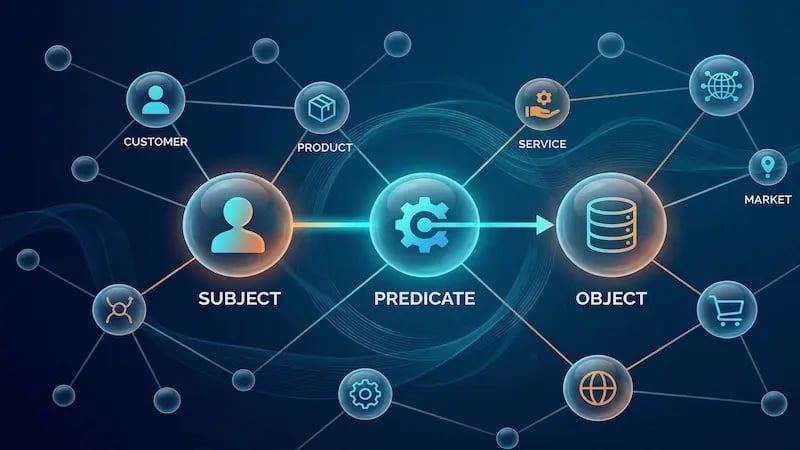
At its heart, a semantic triple is the smallest unit of data that conveys a complete thought to a machine. It is the DNA of the modern web. To understand it, think back to your primary school grammar lessons. A triple consists of three distinct parts:
-
The Subject: The entity or thing you are talking about (e.g., Your Brand).
-
The Predicate: The relationship, action, or property (e.g., Provides).
-
The Object: The value or the goal (e.g., Cloud Security).
When you combine them—”Brand X provides Cloud Security“—you have created a clear, unambiguous data point.
Why does this matter forAI in marketingandfor AEO?Because LLMs like GPT-4 or Gemini don’t “read” like humans. They parse text to build a Knowledge Graph—something that represents a network of real-world entities (such as objects, events, situations, or concepts)—and illustrates the relationshipsbetween them.
This is a distinct contrast as marketingcopy is often full of descriptive, yet superfluous words to ping SEO and hit a word count. While humans might enjoy a flowery description, an LLM might get lost in the adjectives. By using a semantic triple, you are essentially handing the AI a pre-packaged fact that it can easily index and repeat to a user.
Research shows that when content is grounded in these clear relationships, the accuracy of AI responses skyrockets. In one study,
An LLM’s ability to answer business-specific questions jumped from 16% to 54% simply by using a semantic layer to organize the information.
The Death of Word Countsand the Birth of Clarity
For years, SEO experts told us to write long, “comprehensive” guides. The goal was to stay on the page as long as possible. But in the age of Answer Engine Optimization, brevity and clarity are the new kings.
Think about how you talk to a friend. You don’t say,
“In the realm of modern digital interconnectedness, it is often found that the most effective way to achieve a state of physical fitness is through the consistent application of cardiovascular exercise.”
You say,
“Running improves heart health.”
The second sentence is a perfect semantic triple.
- Subject: Running
- Predicate: Improves
- Object: Heart health
When you write for LLMs, you need to adopt this Direct-Firstapproach. This doesn’t mean your writing has to be boring. It just means your core facts should be easy to find.
Consider this:
41% of SEO professionals are now specifically optimizing their content to be included in AI Overviews rather than just ranking in the top ten blue links.
To win that spot, your content must be the most “parsable” answer available.
Why LLMs Hallucinate (And How Triples Fix It)
We have all heard about AI hallucinations—those moments when a chatbot confidently tells you something that is completely wrong. This usually happens because the AI found conflicting information or the source text was too vague.

When you use semantic triples in your product descriptions and blog posts, you are providing a Single Source of Truth.You are telling the AI exactly what the relationship is between your product and the solution it provides.
By structuring your data this way, you reduce the noise the AI has to filter through. This is particularly important for B2B companies with complex offerings. If an AI agent is researching vendors for a client, it needs to know exactly what you do. If your website says you “empower holistic synergy,”the AI might skip you. If it says “Software X automates payroll taxes,” the AI knows exactly where you fit in the Knowledge Graph.
The impact is measurable.
Companies that focus on clear semantic structures have seen their mentions in AI-generated answers increase by 58%.
How to Implement Semantic Triples in Your Strategy
You don’t need to rewrite your entire website overnight. Instead, focus on High-Value Fact Density.Here is a simple framework to follow:
1. The “Answer-First” Paragraph
Start your sections with a clear statement of fact. If a user asks,
“What are the benefits of AI in marketing?”
Your first sentence should be:
“AI in marketing increases lead conversion and reduces manual tasks.”
This is a triple that the LLM can grab immediately. Save the stories and analogies for the second and third sentences.
2. Use “Is-A” and “Has-A” Logic
To help an AI categorize your brand, use clear relational verbs.
These simple connectors are the bread and butter of Knowledge Graphs. They allow the AI to place your brand accurately within a category.
3. Audit for Ambiguity
Look at your current headlines. Do they tell the reader (and the bot) exactly what is on the page? Instead of a headline like:
“The Future of Success,”
try,
“Semantic Triples improve AI visibility.”
The latter tells the AI exactly what the subject and the benefit are.
The Shift to Answer Engine Optimization (AEO)
As we look toward 2027 and beyond, the focus of marketing is shifting from “Traffic” to “Visibility.” In a world of zero-click searches, a visit to your website is less common, but a mention of your brand by an AI is incredibly valuable.
Data shows that AI-referred visitors—those who actually click through from an AI answer—convert at a 4.4x higher rate than traditional search traffic.
Why? Because the AI has already vettedthem. The user arrives on your site already convinced that you have the answer they need.
This is why mastering the semantic triple is so critical. It isn’t just about being found; it’s about being understood. When an LLM understands your value proposition, it becomes your most powerful brand advocate.
From Generative AI to Autonomous Agents
The next step in this evolution is the move from Generative AI (which writes text) to Autonomous Agents (which do the work). These agents will book meetings, buy software, and research competitors on behalf of human users.
For an autonomous agent to act, it needs data it can rely on. It needs to know that “Product A is compatible with System B.” By architecting your content with semantic triples, you are essentially building an instruction manual for the AI agents of the future.
Organizations that have already started building these Semantic Layersinto their content management systems,
Report a 40-50% reduction in the time it takes to maintain and update their digital assets.
It makes your content modular, reusable, and most importantly, machine-readable.
The Human Element: Staying Readable
You might worry that writing for machines will make your content feel robotic. But here is the secret: Humans actually prefer clear, concise information, too.
A high Flesch Reading Ease score (aiming for 70 or above) means your content is easy to digest. Using short sentences, active verbs, and clear subjects doesn’t just help the AI—it helps the busy marketing executive who is skimming your blog post on their phone between meetings.
Think of it as clean writing.You are stripping away the jargon that masks a lack of substance and replacing it with direct, data-backed insights. This builds trust with both the human reader and the digital assistant.
Building Your Single Source of Truth
To truly master AI in marketing, you need to think about your data ecosystem. It’s notjust about one blog post; it’s about how your website, your HubSpot Knowledge Base, and your internal documents all speak to each other.
Are they all using the same semantic triples to describe your services? Or is there a conflict? If your blog says you are an “AI agency” but your LinkedIn says you are a “Marketing Consultancy,” you are creating a “semantic gap” that confuses LLMs.
Aligning these definitions across all platforms ensures that whenever an AI encounters your brand, it gets a consistent, factual message. This consistency is what transforms a brand from a mere search result into an authoritative entity.
Your Path to AI Authority
The landscape of search has changed forever. We are no longer just optimizing for keywords; we are architecting for intelligence. By mastering the semantic triple, you are giving your brand a voice in the conversations happening inside the “brains” of LLMs.
This strategy is about more than just staying relevant; it’s about leading the way. It’s about being the brand that an AI trusts enough to recommend to a user. It’s about being the Single Source of Truthin a sea of digital noise.
Navigating this shift can feel overwhelming. How do you balance the needs of AEO with the creative spark that makes your brand unique? How do you ensure your private data is structured correctly for AI training?
At Aspiration Marketing, we specialize in this exact transition. We help brands move from traditional SEO to a robust, AI-ready visibility strategy. Whether you are looking to optimize your HubSpot Knowledge Base or build an AI-powered flywheel for your lead generation, we provide the expert insights and technical strategy you need to thrive.
The future of search is conversational, direct, and data-driven. Is your content ready to answer the call?