Products You May Like
Is your content library a bridge to the future or a weight pulling you down? For years, marketing teams meticulously built “content moats”—hundreds of blog posts designed to capture the eyes of Google’s 2020 algorithms. But as we move through the year, the landscape beneath our feet has shifted. We aren’t just writing for humans anymore; we are writing for the AI models that talk to them.
 If your legacy content feels like it’s losing its grip on the market, you aren’t alone. The shift from traditional SEO to Answer Engine Optimization (AEO) and Generative Engine Optimization (GEO) has changed the rules of engagement. It’s no longer about ranking for a keyword; it’s about being the definitive answer that an AI agent provides to a user.
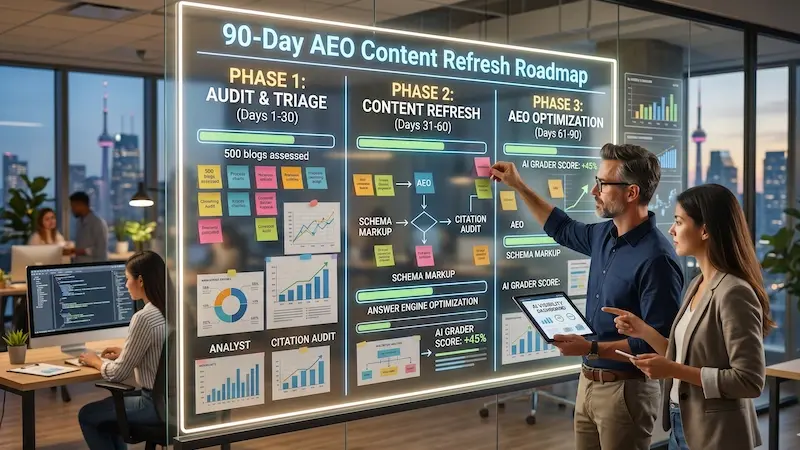
How do you fix a library of 500+ legacy blogs without losing your mind? You need a tactical, 90-day transformation. This is your roadmap to turning those legacy assets into AI-ready powerhouses.
The Content Liability: Why 2020 SEO Fails
Let’s be direct: your old content is likely costing you money; it’s not performing anymore, and you’re paying a subscription to a platform that is just “hosting” the blogs for you. Most blogs written five years ago were padded with “SEO fluff”—repetitive introductions and long-winded prose meant to keep a reader on the page. In the age of Perplexity, SearchGPT, and Claude, that fluff is digital noise. AI models prioritize “citability” and “answer density.” They want the facts, the data, and the structured logic.
The numbers reveal a massive shift in how information is consumed.
According to research from Statista,
The generative AI search market is projected to grow at a staggering compound annual growth rate (CAGR) of 35.6% through 2030, with a significant portion of that acceleration occurring right now in 2026.
Furthermore, recent data from Forbes Advisor indicates that,
56% of consumers now specifically use AI to assist with information gathering and research, preferring the synthesized answers of a bot over scrolling through pages of blue links.
If an AI cannot parse your site, you are invisible to more than half of your potential market. The goal of a content refreshisn’t just to update the “published” date. It’s to make your content machine-readable and authoritative enough to be the primary source for an AI’s answer.
Phase 1 (Days 1–30): The “Answer-First” Audit
You cannot fix what you cannot measure. The first month of your roadmap is about triage. Which of your 500+ blogs are actually worth saving, and which need a total rebuild?
1. Beyond the Rank: Using the AEO Grader
Traditional SEO tools tell you where you rank on a results page. An AEO Grader, however, tells you your “Share of Model.” It measures how often your brand is cited in AI responses. During your first 30 days, run your high-traffic pages through an AEO audit.
-
Action: Identify pages with high “human” traffic but zero AI citations. These are your biggest opportunities for a lift.
-
Question to ask: Does this page answer a specific question in the first 100 words?
2. The Citation Audit: Tracking Your Footprint
AI models don’t just look at your site; they look at what the rest of the web says about you. This is known as the Citation Audit. You need to know whether Perplexity is pulling accurate pricing or feature data. If the AI is hallucinatingabout your brand, it’s often because your own site lacks a clear, factual structure.
3. Prioritizing the “High-Intent” 20%
In the decision stage of the buyer’s journey, you don’t need to refresh every “Top 10 Tips” post. Focus on the 20% of your content that drives actual revenue.
These are your:
This is where your content refresh will yield the highest ROI.

Phase 2 (Days 31–60): The Machine-Readable Overhaul
Once you know which pages to target, the work moves to the “bones” of your content. This is where technical AEO meets expert writing.
1. Implementing “Answer-First” Architecture
AI agents are “lazy”—they want the best answer with the least amount of processing power. If your blog puts the answer at the bottom of the page, the AI might miss it.
-
The Strategy: Use the “Inverted Pyramid” style. State the answer clearly at the top. Use bold text for key conclusions.
-
Example: Instead of “In this blog, we will discuss why AEO matters,” start with “AEO matters because AI search volume is growing by 300% annually, requiring sites to use structured data for visibility.”
2. The Power of Schema and JSON-LD
Schema isn’t just for rich snippetsanymore. It is the language AI uses to understand your site’s hierarchy. By batch-processing Schema updates—specifically FAQPage, Product, and HowTo markup—you provide a “cheat sheet” for the AI.
3. Removing “SEO Noise”
Eliminate overused phrases and fluff. If a sentence doesn’t add a new fact or provide a clear instruction, delete it. AI models favor high information density. Today, a 1,200-word blog with zero fluff, answer-first architecture, and the use of a semantic triple structure outranks a 3,000-word “skyscraper” post filled with filler.
Phase 3 (Days 61–90): Optimizing for Agentic Workflows
By the third month, your content should be clean, structured, and cited. Now, we optimize for the next frontier: AI Agents.
1. Preparing for “Task Bots”
We are moving from “Ask me anything” to “Do this for me.” AI agents, like OpenAI’s Operator or HubSpot’s Breeze Agents,are now performing tasks like “Find me the best HubSpot partner for a mid-sized law firm.”
-
The Goal: Your content must be formatted so a bot can extract data points—like pricing, service areas, and compatibility—without human intervention.
-
The Tactic: Use clear tables and bulleted lists for all technical specifications. Bots love tables.
2. Multimodal AEO: Optimizing Beyond Text
AI can “see” now. During your refresh, ensure your images have descriptive, data-rich Alt-Text. If you have a video, provide a full transcript with timestamps. This multimodal AEO ensures that, whether a user searches by voice, text, or images, your content is available.
3. The Quality Lift
While we talk a lot about “machines,” don’t forget the decision-maker.A Marketing Manager reading your blog wants to see authority. Use real-world examples. If you’re discussing a content refresh, show a “Before and After” of a paragraph. This builds the trust needed to turn a reader into a lead.
- The Data Point: AI-referred traffic often has a higher conversion rate. Studies show that AI-referred visitors convert at a rate 1.2x higher than traditional organic search because the AI has already “pre-qualified” the answer for them.
Measuring Success: The New KPIs
How do you report this to your VP of Marketing? Traditional sessions and page views are still relevant, but they don’t tell the whole story and more.
-
AI Visibility Score: Use your AEO tools to track how many Answer Enginecitations you’ve gained.
-
Information Density: Is your average “time on page” decreasing while “conversion rate” increases? That’s actually a win. It means people (and bots) are finding their answers faster and taking action.
-
Sentiment and Accuracy: Monitor your Citation Audit. Are the AI models accurately describing your brand? If the hallucinationshave stopped, your refresh is working.
Why the 90-Day Sprint Matters
The transition to an AI-first search world is not a slow evolution; it is a rapid shift. Companies that wait until next year to “fix” their legacy content will find themselves buried under a mountain of un-crawlable data.
By following this 90-day roadmap, you move from a reactive state to a proactive one. You stop worrying about Google’s next update and start building a site that is inherently valuable to the systems that now control the flow of information.
-
Phase 1 gave you the data to stop guessing.
-
Phase 2 gave you the structure to be seen.
-
Phase 3 gave you the authority to be chosen.
Building Your Future with Aspiration Marketing
Transitioning your entire content strategy to AEO can feel like a massive undertaking, especially when you have hundreds of legacy posts to manage. This is where expert partnership makes the difference.
At Aspiration Marketing, we specialize in this exact 90-day transformation, having undertaken it ourselves. We don’t just guess which keywords might work; we use proprietary tools like the AEO Grader to analyze your site’s “machine-readability” and “citability.”
Whether you need a technical audit of your HubSpot site, a citation cleanup, or a complete “Answer-First” rewrite of your content library, we provide the roadmap to ensure your brand isn’t just seen—it’s cited. In a world where AI agents are the new gatekeepers, don’t leave your visibility to chance.
Are you ready to turn your legacy content into an AI-driven growth engine? Let’s start your 90-day transformation today.