Products You May Like
Are you truly maximizing your CRM investment, or are software friction and low adoption quietly undercutting your team’s growth targets?
For mid-market technology and SaaS organizations across Canada, scaling revenue requires more than just buying software. It requires an engine that seamlessly connects marketing, sales, and customer operations.
 The modern HubSpot CRM platform offers the architecture to make this happen. Yet, purchasing licenses is only the first step. The real challenge lies in execution.
Industry data shows that,
94% of tech companies have adopted CRM systems, yet average CRM user adoption across industries hovers around just 26% when implementations lack strategic guidance.
Buying a platform is simple; getting your team to use it effectively is where projects succeed or fail.
When Canadian firms evaluate HubSpot services in Canada, they often face a crowded marketplace. Many agencies claim expertise, but few understand the operational realities of mid-market technology companies. Selecting the right HubSpot implementation partner demands a clear evaluation framework.
Below is a structured guide outlining the 10 essential criteria to help you choose the ideal provider for your organization.
How to Choose HubSpot Services in Canada
Section 1: Strategic & Ecosystem Alignment Criteria
1. Tier Status vs. True Accreditations
Does the partner hold verified technical accreditations, or are they relying solely on sales tier badges?
When searching for a partner, tier badges like Gold, Platinum, Diamond, or Elite catch your eye quickly. However, sales tiers primarily reflect the volume of software licenses an agency sells, not necessarily itstechnical proficiency.
Instead, look for official HubSpot Accreditations. HubSpot awards these credentials only after auditing an agency’s technical work, security practices, and client outcomes. An agency holding accreditations in custom integrations or complex data migrations has proven its ability to handle demanding technical environments.
The business impact of selecting the right guide is measurable.
According to HubSpot’s partner ROI benchmarks,
Businesses that work with certified partners generate 53% more inbound leads and close 3x more deals compared to teams that attempt self-implementation.
2. Specialized SaaS and B2B Tech Expertise
Do they understand the unit economics, sales cycles, and tech stacks unique to mid-market tech companies?
A generic CRM setup will not support a modern technology firm. B2B SaaS companies operate on distinct business models that demand precise tracking. Your provider must understand metrics like:
-
Monthly Recurring Revenue (MRR)
-
Annual Contract Value (ACV)
-
Churn Rates and Net Retention
-
Customer Acquisition Cost (CAC) vs. Lifetime Value (LTV)
If a service provider builds standard, linear pipelines designed for simple e-commerce products, your team will struggle. Your partner must know how to map product usage data, trial sign-ups, and product-led growth (PLG) triggers directly into your CRM workflows.
3. Regional & Canadian Market Understanding
Are they equipped to handle Canadian compliance, dual-language needs, and regional go-to-market strategies?
Working with local specialists offers clear operational advantages. Canadian tech companies must navigate specific legal and cultural landscapes.
First, consider compliance. Your partner must understand Canadian data privacy regulations under PIPEDA and the strict consent requirements enforced by Canada’s Anti-Spam Legislation (CASL). Mishandling contacts during a database migration can result in significant legal fines.
Second, market presence matters. Many Canadian tech firms operate across bilingual markets or target both Canadian and US buyers. Your partner should know how to configure multi-currency settings, manage regional tax structures, and build dual-language assets (English and French) for nationwide campaigns.
4. Cross-Hub Technical Architecture & App Integration
Can the partner unify Marketing Hub, Sales Hub, Service Hub, and Operations Hub with your existing software stack?
Mid-market technology companies rarely rely on a single software application. Your ecosystem likely includes tools like Salesforce, Stripe, Zendesk, Snowflake, or proprietary software platforms.
![A detailed infographic illustrating the integrated "Unified HubSpot Ecosystem" for a Canadian business. A large central blue panel is labeled "CENTRAL CRM DATA ENGINE." Four smaller, stylized blue panels with distinct icons and orange data arrows show other HubSpot Hubs feeding into the Central Data Engine: [Marketing Hub] with a rocket/funnel icon, [Sales Hub] with a handshake/graph icon, [Service Hub] with a headset/ticket icon, and [Ops Hub] with a gear/automation icon. Below the central engine, a large white panel details external connections, labeled "[Billing Systems | ERPs | Data Warehouses]" with icons for stacked coins, a bank-style building, and a data stack. Bidirectional orange and light blue arrows connect the Central Data Engine to this lower panel, with text reading "Custom APIs & Integrations." The entire ecosystem is contained within a glowing blue digital screen interface with visible circuit patterns, set against a blurred, modern open-plan office background with desks and potted plants, visible through large windows.](https://blog.aspiration.marketing/hs-fs/hubfs/Unified%20HubSpot%20Ecosystem.webp?width=800&height=436&name=Unified%20HubSpot%20Ecosystem.webp)
Data silos create severe operational friction. Gartner research shows that
48% of businesses report that data silos prevent them from delivering a consistent customer experience.
A qualified provider evaluates your whole tech stack. They design custom API connections or utilize Operations Hub to keep data moving smoothly between your databases. This gives your leadership team a single, reliable view of the entire customer lifecycle.
Section 2: Operational & Execution Excellence Criteria
5. Structured 30-60-90 Day Implementation Methodology
Do they follow a defined roadmap with clear time-to-first-value milestones, or an unstructured hourly model?
Unstructured implementations often drag on for months, depleting resources and delaying revenue goals. You need a partner with a clear, repeatable methodology.
Standard internal implementations can take up to 90 days or longer to show results.

In contrast,
Structured partner-guided rollouts compress that timeline down to 45 to 60 days—an acceleration of up to 40%.
| Implementation Phase | Focus Areas & Deliverables | Operational Goal |
|
Month 1(Days 1–30) |
Technical setup, domain validation, property mapping, and data migration. | Establishing a clean data foundation. |
| Month 2(Days 31–60) | Pipeline design, lead scoring rules, deal stage automation, and core integrations. | Enabling operational sales workflows. |
| Month 3(Days 61–90) | Executive dashboards, role-based training, and multi-touch attribution setup. | Achieving full team adoption and visibility. |
6. Data Migration & Governance Strategy
How will they handle legacy data cleaning, mapping, and ongoing data hygiene?
Migrating data from legacy systems like Salesforce, Pipedrive, or Excel spreadsheets is a critical phase of any onboarding project. Importing messy or duplicate records into a fresh portal quickly undermines user confidence.
Data quality issues are widespread across the corporate sector.
Gartner data research reveals that,
45% of CRM leaders admit their organizational data is not ready to support advanced AI or workflow automation.
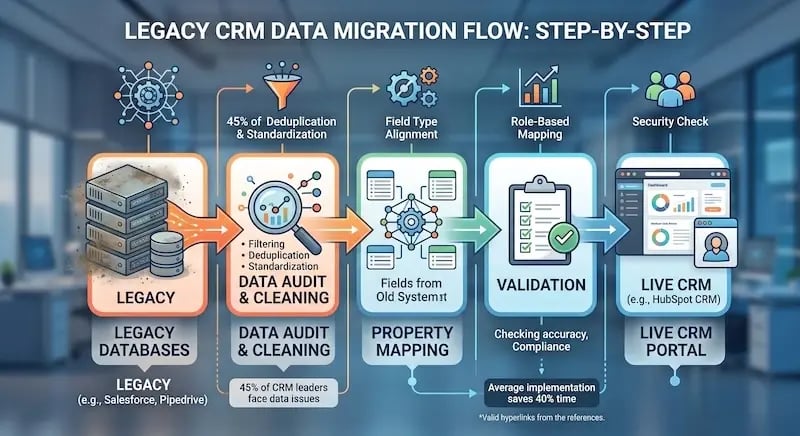
AdisciplinedHubSpotSolutions Partner in Canada performs a thorough data audit before moving a single contact. They deduplicate files, map custom properties carefully, and establish governance rules to keep your data clean over the long term.
7. Change Management & Role-Based Enablement
Does the engagement plan include tailored team training, or just standard video tutorials?
Software fails when people refuse to use it. If your sales reps feel that the CRM simply adds administrative friction, they will revert to spreadsheets or offline notes.
According to research from Nucleus Research,
Providing sales representatives with well-integrated, easily accessible CRM workflows can shorten overall sales cycles by 8% to 14%.
Effective partners do not hand you a folder of generic training videos. They host live, role-based coaching sessions tailored to your specific workflows:
Section 3: Value, Analytics, & Partnership Growth Criteria
8. Advanced Reporting & Revenue Attribution Capability
Will they help you build multi-touch attribution models to prove ROI across marketing and sales channels?
Many mid-market leaders struggle to connect marketing investments directly to revenue closed by the sales team. Generic onboarding services often provide standard, out-of-the-box dashboards that track basic metrics such as email opens and page views.
Your business requires clear visibility into revenue drivers. A sophisticated service partner configures custom multi-touch attribution models. They help you trace how a target account first discovered your brand, which content assets they consumed during the consideration stage, and which sales interactions ultimately closed the deal.
This level of reporting turns your CRM into a strategic decision-making platform for executive leadership.
9. SLA Transparency and Ongoing Optimization Models
What happens after initial onboarding—do they disappear, or do they provide continuous strategic support?
A CRM rollout is not a static, one-time project. As your technology firm launches new product lines, enters new geographic markets, or expands its sales force, your platform must adapt.
Avoid service providers that deliver a portal and immediately walk away. To properly evaluate a HubSpot partner, evaluate their ongoing support models:
-
Do they offer flexible, high-level RevOps advisory services?
-
Are Service Level Agreements (SLAs) clearly defined for technical troubleshooting?
-
Do they conduct quarterly strategy reviews to refine your workflows based on actual performance data?
Continuous optimization ensures your system evolves alongside your business growth, preventing technical debt from accumulating over time.
10. Clear Proven Track Record & Canadian Case Studies
Can they provide verifiable case studies and client references from mid-market tech firms in your region?
Before finalizing any contract, examine the provider’s track record. Ask for detailed case studies involving companies with business models, team sizes, and technical complexities similar to your own.
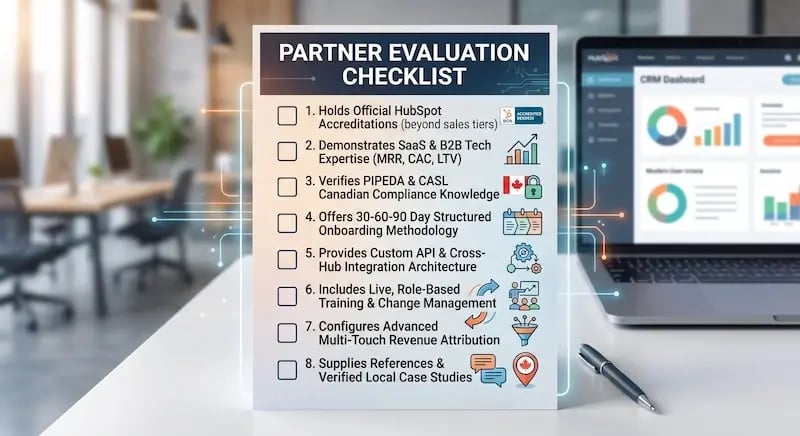
Speak directly with past clients if possible. Ask about the provider’s communication style, their ability to meet project deadlines, and how effectively they handled unexpected technical challenges during migration. Reliable partners will gladly share client references and metrics that validate their work.
Turning Your CRM Into a Scalable Revenue Engine
Selecting the right provider for HubSpot services in Canada requires evaluating far more than baseline pricing or sales-tier badges. By focusing on technical accreditations, regional compliance, structured change management, and RevOps alignment, Canadian tech executives can avoid costly deployment errors and maximize platform ROI.
Navigating these criteria ensures your software becomes a true engine for growth rather than an operational burden. At Aspiration Marketing, as a certified HubSpot Solutions Partner, we help Canadian mid-market tech and SaaS organizations design, implement, and scale custom HubSpot ecosystems tailored to complex business goals.
Ready to evaluate your current system or plan your next onboarding step? Reach out to schedule a technical HubSpot alignment assessment today.