Products You May Like
Are you writing content that brilliant human minds love, but AI crawlers entirely ignore? If your content does not get cited by AI engines, does it even exist?
 For years, content marketing followed a clear, predictable path. You found relevant keywords, built high-quality backlinks, and wrote long, detailed articles to increase human dwell time. While this strategy worked perfectly for traditional search engines, the digital landscape is changing fast. The rapid rise of Generative Engine Optimization (GEO) and Answer Engine Optimization (AEO) means marketers must now adapt to a secondary gatekeeper: the Large Language Model (LLM) ingestion engine.
When you focus on writing content for LLMs, you change your primary target audience. You are no longer just writing for a human reader; you are writing for the machine that synthesizes and feeds information to that reader. High-quality, nuanced B2B or technical contentis frequently over-engineered. When an LLM processes complex prose, excessive jargonand winding syntax introduce statistical noise. This noise confuses the model, causing it to skip your page entirely in favor of cleaner, simpler sources.
The financial stakes of this shift are massive.
According to recent search landscape research by Urban Element, B2B websites see LLM-sourced referral traffic convert at an average rate of 18% to 24%.
This rate significantly outperforms traditional organic search conversions. If your content is toocomplex for an AI engine to read efficiently, you are actively missing out on high-intent buyers.
To win in this new era, you must master technical readability. This means designing your text so that AI models can ingest, process, and quote your insights without structural friction. Let us look at how you can optimize your content for the age of AI search.
How Large Language Models Process Your Content
To write content that AI engines love, you must first understand how they read. Machines do not read words the way humans do. They do not feel emotion, and they do not appreciate clever metaphors or poetic prose. Instead, they treat text as data.
When an AI crawler visits your website, it scrapes the text and breaks it down through a primary step called tokenization. A token is a small fragment of text, usually consisting of a few letters or a single word. Complex phrases create highly fragmented token arrays. When your sentences are long and full of rare words, the model must work harder to find meaning. This increases the AI company’s computational costs and, more importantly, reduces the semantic clarity of your text.
LLMs view content depth in a unique way. For a human reader, depth means comprehensive, nuanced prose. For an LLM, depth means a dense collection of highly accessible, clean facts.
A recent study by Newsdata.io shows that AI engines heavily favor text that removes unnecessary fluff.
They look for direct answers to specific queries rather than narrative journeys.
Why do machines struggle with complex writing? The answer lies in statistical noise. LLMs predict the next word in a sequence based on mathematical probability. Metaphors, idioms, and passive framing distort these probabilistic relationships. If a model cannot cleanly extract a fact during its retrieval phase, it will drop your site and rely on an alternative source that presents the data more clearly. Writing content for LLMs requires you to eliminate this structural friction entirely.
The Pillars of Technical Readability for AI Ingestion
How do you make your content easy for a machine to ingest? You must focus on three core pillars of technical readability. These pillars ensure your content meets the strict standards of AI data-ingestion tools.
1. Plain Syntax and the 8th-Grade Reading Target
Why should you aim for an 8th-grade reading level when writing about advanced technical or B2B topics? This choice is not about dumbing down your insights for human readers. Rather, it is about minimizing structural overhead for the AI parser.
When you write simply, the machine can easily map your points.
Peer-reviewed evaluation metrics published via PubMed Central show that when text is left overly dense, an LLM’serror rate can spike up to 75%, dragging overall processing accuracy down from 62.7% to a staggering43.6%.
Simple text leads to lower error rates, prevents the model from hallucinating or making up facts, and therefore makes it easier for an answer engine to pull data from.
To hit this target, keep your sentences relatively short. Try to ensure each sentence stays under 15 to 20 words, and avoid non-essential, multi-syllabic verbs. Use plain words like “use” instead of “utilize,” and choose “help” instead of “facilitate.” This simple shift keeps your token count clean and predictable.
2. Clear Syntax and Active Voice
Passive voice is a major enemy of Answer Engine Optimization. What you see is the incorporation of the Semantic Triple. Consider this passive sentence:
“The strategy was implemented by the marketing team.”
This structure splits the subject and the action, which confuses the early-stage dependency parsers that AI scraper engines use to map text.
Now, look at the active version:
“The marketing team implemented the strategy.”
This sentence creates a direct, predictable sequence in which the subject clearly acts on the object. LLMs can easily parse this relationship and instantly see who performed the action. When you review your drafts, eliminate passive verbs and make your sentences direct, punchy, and clear.
3. Explicit Data Structures and Semantic Markers
A clear layout is essential for machine readability. LLMs love structured data because it provides immediate, unambiguous context. Tables, bulleted lists, and explicit definitions serve as critical-importance markers on the page.
As noted by Newsdata.io, AI engines actively hunt for these markers when they synthesize real-time web searches.
A bulleted listsignals to the crawlerthat these items belong to thesame category. Meanwhile, a table shows clear relationships between data points. This structure allows the model to extract facts instantly without reading thousands of words of narrative prose to find a single metric.

Designing Content for High-Yield Ingestion: Structural Frameworks
Knowing the rules is a good start, but you also need a framework. To optimize your brand for AEO, you must structure your pages with mathematical precision.
The 30% Retrieval Rule
Where you put your information matters just as much as how you write it.
Data from Urban Element reveals that 44% of all LLM citations are pulled exclusively from the first 30% of an article.
This means you cannot afford to bury your lead or save your best insights for the conclusion. Place your core thesis, primary answers, and critical statistics directly in the introduction and the first H2 sub-heading. Or even better, start your blog with a TL;DR section. If a user asks a specific question, answer it in the very first paragraph of that section. This immediate placement gives the AI crawler exactly what it needs before it moves on to another site.
Strict Heading Hierarchies (H1 → H2 → H3)
Do not use heading tags like H2 and H3 just to alter font sizes for visual appeal. Use them to build a logical ladder of information. LLM web crawlers map knowledge graphs using strict nested structures.
-
H1 Tag: The overarching topic or title.
-
H2 Tags: The primary subtopics or categories.
-
H3 Tags: The specific supporting details under those categories.
Never skip a heading level for aesthetic reasons. Do not jump from an H2 straight to an H4. If you break this organizational structure, the AI scraper might misunderstand how your subtopics relate to the core theme.
The Inverted Pyramid for Machines
To maximize your visibility in AI search, use the inverted pyramid framework for every single section. State the core insight immediately under the heading, unpack it with two or three direct sentences, and follow it with an explicit data table or structured list.
This layout creates a perfectflow for both audiences. The machine gets the quick answer it needs for voice search or quick summaries, while the human reader gets the deeper context if they choose to read further down the page.
Common Pitfalls: What Causes an LLM to Reject Your Content?
Many content creators make subtle mistakes that ruin their AI search visibility. If you want to succeed at writing content for LLMs, you must avoid these three major pitfalls.
Pitfall 1: Over-reliance on Figurative Language
We all love creative writing, but clichés, sarcasm, and industry-insider metaphors severely undermine technical readability. If you write that your new software is “a home run,” a human understands the positive meaning. However, an AI model might take that phrase literally and look for context about sports. This mismatch creates semantic drift, causing the model to lose track of your true message and skip your page entirely. This is where a Human-in-the-Loop comes in handy. They can sanity-check whether something is readable by both humans andAI.
Pitfall 2: Technical Jargon without Immediate Context
It is fine to use specialized industry terms. In fact, LLMs need specific terminology to match niche user queries. The mistake is using these terms without a clear definition. The first time you use a complex piece of jargon, provide a standard dictionary-style definition directly adjacent to it using a simple phrase like, “X means Y.” This explicit pairing tells the AI engine exactly how to interpret the word within your specific context.
According to RAG engineering research published via ResearchGate, when there’s complex jargon with no definition, the AI engine can miss up to 30% to 50% of the relevant information sitting right there on the page.
If it can’t map an obscure term to the user’s search prompt, it skips over you.
Pitfall 3: Obfuscated Data Layouts
Burying important operational metrics inside complex, narrative walls of text is a highly damaging practice. If your article contains a great statistic, do not hide it in the middle of a fifty-word sentence. Pull it out and put it in bold text. Better yet, create a clean key-value pairing or a markdown table. If the data is hard to find, the machine will simply act as if it doesn’t exist because it can’t extract it.
Practical Steps to Audit Your Content Library
Now that you understand the pillars of technical readability, how do you apply them to your website? You should run a comprehensive content audit focused specifically on AI ingestion. Follow these steps to upgrade your existing pages.
Step 1: Check Your Readability Scores
Use a reliable editing tool to measure your Flesch Reading Ease score. For an optimal balance of professional tone and machine readability, aim for a score between 60 and 70. If your score falls below 60, your text is too complex. Break up long sentences, replace overly long words with simpler alternatives, and remove unnecessary adjectives.
Step 2: Audit Your Structural Layouts
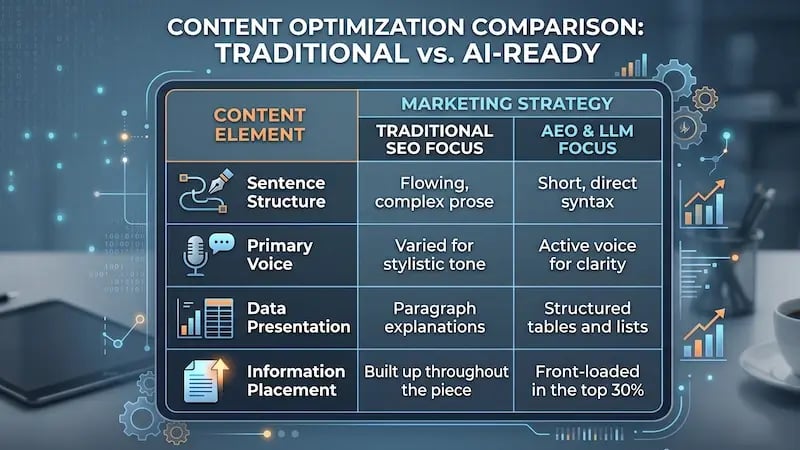
Review your formatting and examine your text blocks closely. If a paragraph is longer than five lines, break it into smaller pieces to avoid dense walls of text. Add clear bullet points to lists of items and turn descriptive comparison paragraphs into clean data tables, like the one below:
Step 3: Test Content Against AI Prompts
Copy a section of your text and paste it into a primary LLM. Ask the model to summarize the main points. If the summary misses your core message, your writing is not clear enough. Rewrite the section using active voice and simpler syntax, and repeat this process until the machine extracts the correct facts every single time.
Driving Visibility in the Age of AI Search
Technical readability is the new bridge connecting your expert insights to generative search engines. The rules of online visibility have fundamentally changed, and you can no longer rely solely on legacy SEO practices. By optimizing for clean syntax, targeting an 8th-grade reading level, and structuring data transparently, you protect your digital visibility and ensure your hard work gets found, read, and cited by the next generation of search tools.
Content marketers must treat AI models as a vital audience tier alongside human readers. When you focus on writing content for LLMs, you open the door to highly valuable, high-converting referral traffic, positioning your brand as a trusted authority in an automated world.
If you want to master this new search landscape, you do not have to navigate it alone. Aspiration Marketing helps brands scale their visibility across the AI-driven search ecosystem. We specialize in Large Language Model Optimization (LLMO) and technical content strategy, while providing comprehensive GEO tracking services to measure your impact. With our expert guidance, you can ensure your brand remains highly visible, cited, and recommended across all primary generative models.
Partner with us today to secure your place at the top of AI search results.