Products You May Like
We all know that our phones have GPS. We take it for granted that our devices know exactly where we are standing at any given second. But there is a massive difference between a device knowingsomeone’slatitude and longitude and an AI agent knowing that your business is the best solution for a user in that specific spot. When someone asks a virtual assistant, “Where should I go for a quick lunch near me?” or “Who is the most reliable plumber in this zip code?”, the GPS provides the “where,” but the AI provides the “who.”
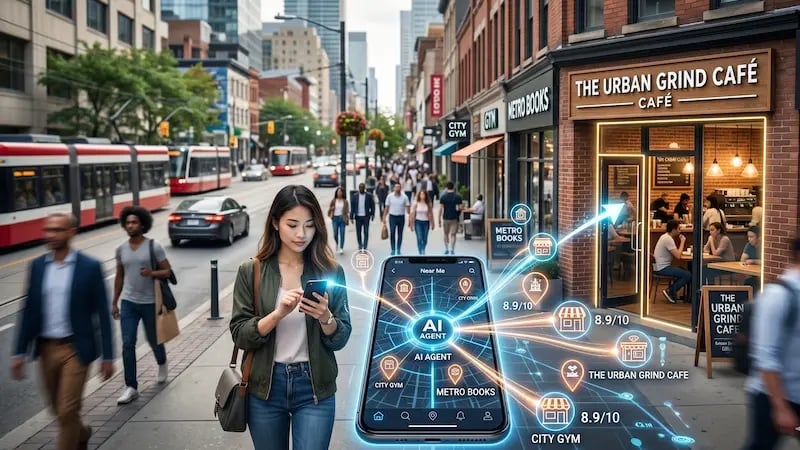 In the past, we called the struggle for that recommendation Local SEO. Today, we are entering the era of Local AEO—Answer Engine Optimization. It is no longer enough to be on the map with Yelp reviews and a Google My Business. If you own a business with a physical storefront or a specific service area, the stakes have changed.
| Feature | Local SEO | Local AEO |
|---|---|---|
| Primary Goal | Map Pack Ranking | Direct AI Answer |
You need to ensure that AI agents—the LLMs (Large Language Models) like ChatGPT, Claude, and Gemini—can verify your existence, understand your boundaries, and recommend youwith 100% confidence.
The Shift from Search Results to Direct Answers
For decades, the goal of local marketing was to land in the “Map Pack” on a search results page. You wanted that little red pin to show up when someone typed a keyword. But how do people search now? They talk to their cars. They ask their smart speakers. They type full, conversational sentences into AI chat interfaces.
These Answer Enginesdo not just give a list of links. They provide a single, definitive recommendation. If your data is messy, the AI might experience “location drift.” This is when the AI recognizes your brand but isn’t sure whether you still serve a specific neighborhood or whether your satellite office is still open. When an AI is unsure, it remains silent. To stay relevant, your business must become “AI-visible” through local AEO.
Why Local AEO is the New “Near Me” Currency
Why should you care about this shift? The numbers tell a compelling story about how consumer behavior is pivoting.
According to a 2024 report from Yext, nearly 77% of consumers now use digital maps or AI-driven apps to find business information before visiting a physical location.
Furthermore, data from eMarketer
Suggests that by 2025, generative AI will be a primary search tool for over 117 million users in the US alone.
When a user asks an AI for a recommendation, the AI looks for groundedfacts. It searches for your address, service radius, and operating hours across multiple sources. If your website says one thing and a local directory says another, the AI’s confidence score drops. Local AEO is the process of cleaning up that digital noise so the AI sees a clear, unified signal.
Building the “Source of Truth” with Structured Data
If you want an AI agent to understand your location, you have to speak its language. That language is Schema Markup. Think of Schema as a digital business card that a machine can read instantly. While humans see a pretty website with photos and text, the AI sees the underlying code.
To optimize for local AEO, you must use specific Schema types like:
-
LocalBusiness
-
PostalAddress
-
GeoCoordinates.
But it goes deeper than that.For businesses that travel to their customers, the ServiceArea property is vital. It tells the AI, “I am located in City A, but I serve everyone within a 30-mile radius.”
Without this structured data, an AI might assume you only help people who stand right on your doorstep. By using theSemantic Tripleapproach—subject (your business), predicate (provides service in), and object (the specific county)—you create a logic chain that an LLM can easily digest and repeat to a user.
Off-Page Signals: The AI’s Verification Process
AI agents do not just trust your website. They “fact-check” you. They crawl third-party review sites, local news outlets, and digital directories to see if other sources agree with you. This is what we call Off-Page AEO.
A BrightLocal survey recently highlighted that 87% of consumers read online reviews for local businesses.
AI agents use these same reviews, but for a different reason. They analyze sentiment and specific location mentions in those reviews. If twenty people write, “Best coffee in downtown Chicago,” the AI builds a strong association between your coffee shop and that specific geographic entity.
Consistency is key here. If your Name, Address, and Phone number (NAP) vary even slightly across the web, it creates entity fragmentation.An AI might think “Main St. Cafe” and “The Main Street Coffee House” are two different places, or worse, that one of them is permanently closed.

The Role of Hyper-Local Content Clusters
How do you prove to an AI that you are an expert in your local area? You write about it. But you must do so in a way that provides actual value. Avoid the old-school tactic of just listing every city name in a footer. Instead, create content clusters that solve local problems.
For example, a roofing company might write a blog post titled “Common Roofing Issues After a [City Name] Hail Storm.” This tells the AI two things:
-
You have the expertise (Roofing).
-
You are physically present and active in [City Name].
This strategy leverages what we call Large Language Model Optimization (LLMO). By creating high-quality, relevant content, you give the AI more “tokens” to associate with your brand during its training. This makes it much more likely that your business will be the one suggested when a local query pops up.
Voice Search and the “Screenless” Challenge
Local search is increasingly eyes-free.Whether someone is using a Siri-enabled earbud or a Google Home in the kitchen, they aren’t looking at a screen of ten blue links. They are hearing one answer.
To win in voice-based local AEO, your content must be concise. We often recommend using a “TL;DR” (Too Long; Didn’t Read) summary at the top of your location pages. This summary should include your address, your primary service, and a clear “Yes” to whether you are open now. If an AI can find this information in a simple, structured format, it can relay it to the user without hesitation.
In fact,
Research from Backlinko found that the average voice search result is only about 29 words long.
This means your most important location facts must be punchy, direct, and easy for a machine to speak aloud.
Using FAQs to Boost Your Local Presence
One of the most effective ways to capture local intent is through a robust FAQ section. Why? Because people ask AI agents questions. If your website contains the exact question and a direct, data-backed answer, you are essentially handing the AI its script.
A local law firm might include an FAQ like:
“Do you offer free consultations for residents in North Dallas?”
The answer should be direct:
“Yes, we offer 30-minute free consultations for all North Dallas residents at our Preston Road office.”
This provides a clear Semantic Triplefor the AI to index. It connects the service (consultation), the price (free), and the location (North Dallas/Preston Road) in one neat package. This is a primary driver for appearing in “People Also Ask” boxes and AI-generated summaries.
The Importance of Digital PR and Local Citations
AI agents prioritize authoritative sources. If your local chamber of commerce, a local newspaper, or a popular community blog links to your site, that serves as a high-value votein the eyes of an AI.
Think of it as a social hierarchy. The AI sees that the local government website mentions your business as a participant in a community event. It then cross-references that with your Google Business Profile and your website’s Schema markup. When all three align, the AI’s confidence in your location reaches its peak. This is how you move from being a “maybe” to a “definitely” in the eyes of an answer engine.
Monitoring Your AI Reputation
The world of AI is not static. LLMs are updated, their knowledge cutoffsshift, and their training data evolves. This means you cannot just “set and forget” your local AEO strategy. You need to act as a mystery shopper for your own brand.
Try asking different AI platforms about your business:
- “What are the hours for [Your Business] in [City]?”
- “Does [Your Business] offer [Specific Service] near [Neighborhood]?”
- “How do I get to [Your Business] from the airport?”
If the AI gets it wrong, it is a sign that your digital footprint is cluttered. You may need to update your citations, refine your Schema, or produce clearer, location-specific content to “retrain” the AI’s understanding of your entity.
The Future of Local Interaction
As we look ahead, the line between the digital and physical worlds will continue to blur. We are moving toward a future where AI agents act as personal concierges. They won’t just tell a user where you are; they might eventually book the appointment or place the order for them.
For this to happen, the AI needs to have absolute certainty about your operational details. It needs to know not just where you are, but what you do, who you serve, and how you interact with your community. By focusing on local AEO today, you are laying the groundwork for a future where your physical location is always easy to find, no matter which device or platform the customer uses.
Claiming Your Territory in the AI Age
In the fast-moving landscape of modern technology, being invisible to an AI is the same as being closed for business. Local AEO is no longer a luxury for the tech-savvy; it is a fundamental requirement for any business that relies on local customers. It is about being clear, being consistent, and being conversational.
When you provide AI agents with high-quality, structured data and back it up with a consistent off-page presence, you remove the friction between you and your next customer. You ensure that when the question “Where should I go?” is asked, the answer is always your business.
At Aspiration Marketing, we believe that every business deserves to be found. Our team specializes in the nuances of Answer Engine Optimization, helping you bridge the gap between traditional search and the new era of AI-driven results. We don’t just optimize for algorithms; we optimize for the real people searching for your services every single day. Whether you are a single-location boutique or a multi-state service provider, we have the tools and the expertise to ensure your physical presence is felt across the digital world.
Let’s make sure the AI knows exactly where to find you.